Scientific Soil Testing Services
Take the guesswork out of lawn care with a scientific analysis of your soil's health and nutrient levels. We test before we treat.
You Can't Fix What You Can't See
Beautiful, resilient lawns start from the ground up. If your grass is struggling, losing color, or battling weeds, the problem almost always lies beneath the surface.
Stop Guessing
Applying fertilizer without testing wastes money on products your lawn may not even need.
Exact Data
See precise pH levels, macronutrients, and micronutrients in a certified lab report.
Custom Plan
Get a treatment roadmap built specifically for your soil's exact conditions.
What We Test For in Your Soil
Soil pH Balance
Soil pH affects nutrient availability and helps guide corrective recommendations. We test pH to determine if corrective lime treatments are necessary.
Nutrient Deficiencies
We measure exact levels of critical nutrients. Low phosphorus stunts root growth, while low potassium leaves grass vulnerable to drought and disease. We identify gaps to build a custom fertilizer blend.
Organic Matter
Healthy soil benefits from organic matter to retain moisture and support beneficial microbes. When included in the selected package, organic matter is reported as a measured property of your soil; it is not a substitute for a separate soil-texture or compaction test. Those findings help guide our aeration recommendations.
Cation Exchange Capacity (CEC)
This metric tells us how well your soil holds onto nutrients before they wash away. A low CEC means we need to adjust application frequency to ensure your grass gets a steady diet.
The Golden Green Soil Testing Process
Property Visit & Sampling
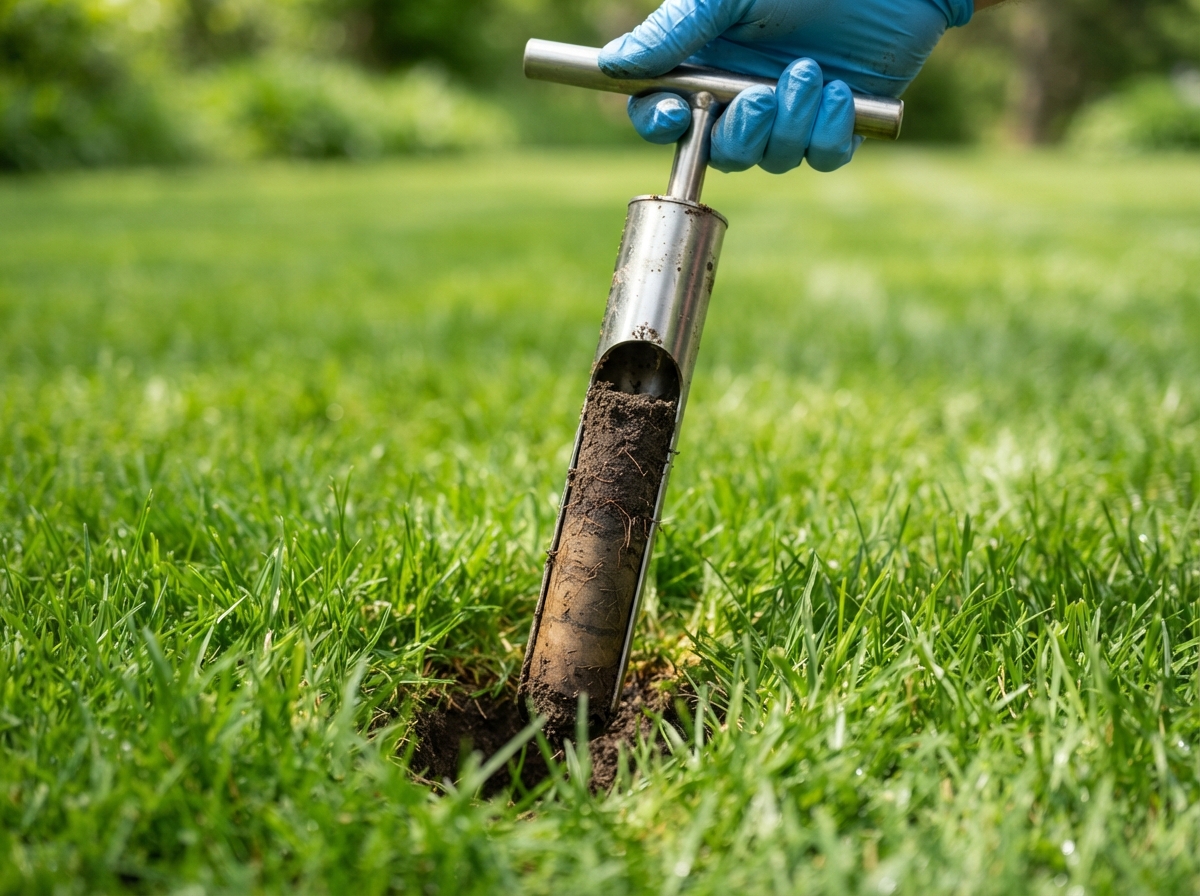
A Golden Green technician visits your property and uses a professional soil probe to pull multiple core samples from various zones of your yard, ensuring an accurate average reading.
Laboratory Analysis
Your samples are sent to an independent agricultural laboratory for comprehensive analysis using certified testing methods.
Results & Plain-English Breakdown
We sit down with you to explain the data in plain English — no confusing jargon, just clear information about what your soil needs.
Custom Treatment Plan
We present a science-backed treatment plan designed specifically to unlock your lawn's full potential based on the lab results.
Ready to Find Out What Your Soil Is Missing?
Stop guessing. Get a professional soil test and a custom treatment plan built on real data.
Including Lehigh County, Berks County, Bucks County, and Northampton County.
Sunny's Seed Promise
Sign up for our 6-step program plus aeration & seeding, and receive unlimited seeding if needed!
2 Free Applications
Add preventative grub control to your 6-step program and get TWO free flea & tick applications!
How Soil Testing Fits Your Lawn Program
A soil test is not a one-time event. It is the starting point for a program that adapts to what your lawn actually needs. Here is how the results connect to the rest of your care.
pH guides lime decisions
If the lab report shows acidic soil, we recommend a lime application calibrated to the exact deficiency — never a guess. If pH is already in range, lime is not added.
Nutrient levels shape your fertilizer blend
Low phosphorus, potassium, or nitrogen each call for a different correction. Your fertilization program is built around the gaps the test reveals, not a generic schedule.
CEC and organic matter guide application frequency
Sandy soils with low CEC lose nutrients quickly and may need lighter, more frequent feedings. Heavier soils hold nutrients longer. The test tells us which approach your lawn requires.
Compaction and thatch point to aeration
When soil conditions suggest compaction or poor drainage, we may recommend mechanical core aeration or liquid aeration to open the soil and support root growth.
What the Numbers on Your Soil Report Mean
A soil test report can look intimidating, but it comes down to a few key measurements. Here is what each one tells us about your lawn.
Soil pH
Measures acidity on a 0–14 scale. Most cool-season turf prefers 6.0–7.0. Below 6.0, nutrients become harder for grass to absorb even when they are present in the soil.
Phosphorus (P)
Supports root development and early seedling establishment. Low phosphorus stunts root growth; high phosphorus can contribute to environmental runoff and is regulated in Pennsylvania.
Potassium (K)
Helps grass withstand drought, cold, and disease. Low potassium leaves turf vulnerable to summer stress and winter injury — common in Eastern Pennsylvania lawns.
Cation Exchange Capacity (CEC)
Measures the soil's ability to hold and supply nutrients. Sandy soils typically have low CEC (5–10); clay and loam soils hold more. CEC helps us decide how often to feed.
Calcium and Magnesium
These secondary nutrients affect soil structure and plant health. If magnesium is low, calcitic lime is preferred; if both calcium and magnesium are low, dolomitic lime may be recommended.
Organic Matter
Supports microbial life, moisture retention, and nutrient cycling. Healthy Pennsylvania lawns typically range from 3–5% organic matter. Low levels may signal the need for soil-building practices.
Soil Testing Questions We Hear
How often should I test my soil?+
For most Eastern Pennsylvania lawns, testing every two to three years is sufficient. New lawns, lawns with persistent problems, or properties that have recently received amendments may benefit from more frequent testing. We will recommend a retesting schedule based on your results.
Do I need to be home for the soil test?+
Not usually. As long as we have access to the lawn, our technician can pull core samples from multiple zones and leave a note summarizing the visit. We coordinate sampling around your schedule.
How long does it take to get results?+
After sampling, the laboratory typically returns results within one to two weeks. We then review the report with you in plain English and present a treatment plan based on the findings.
Can I test my own soil with a home kit?+
Home kits can give a rough pH estimate, but they do not measure nutrient levels, CEC, or organic matter with the accuracy of a laboratory analysis. For decisions that guide a full lawn program, a professional lab test provides the reliable data you need.
What if my soil test shows everything is fine?+
That is good news. It means your current program is working and no corrective amendments are needed. We will continue your fertilization and weed control schedule and retest at the appropriate interval to make sure conditions have not changed.
Will a soil test tell me why my lawn has weeds?+
A soil test identifies nutrient and pH conditions that may favor certain weeds or weaken turf, but it does not directly identify weeds. Thin turf from poor soil conditions creates openings for weeds. Correcting the soil supports thicker grass, which is the first line of weed defense.
Do you service lawns across Eastern Pennsylvania?+
Yes. We service Lehigh, Northampton, Berks, and Bucks counties, including Allentown, Bethlehem, Easton, Reading, Quakertown, Doylestown, and surrounding communities. Request a quote to confirm coverage for your address.