Tall Fescue, Kentucky Bluegrass or Perennial Ryegrass: Which Grass Should You Overseed With in Pennsylvania?
The grass that comes up first is not necessarily the grass you wanted to live with for the next ten years.
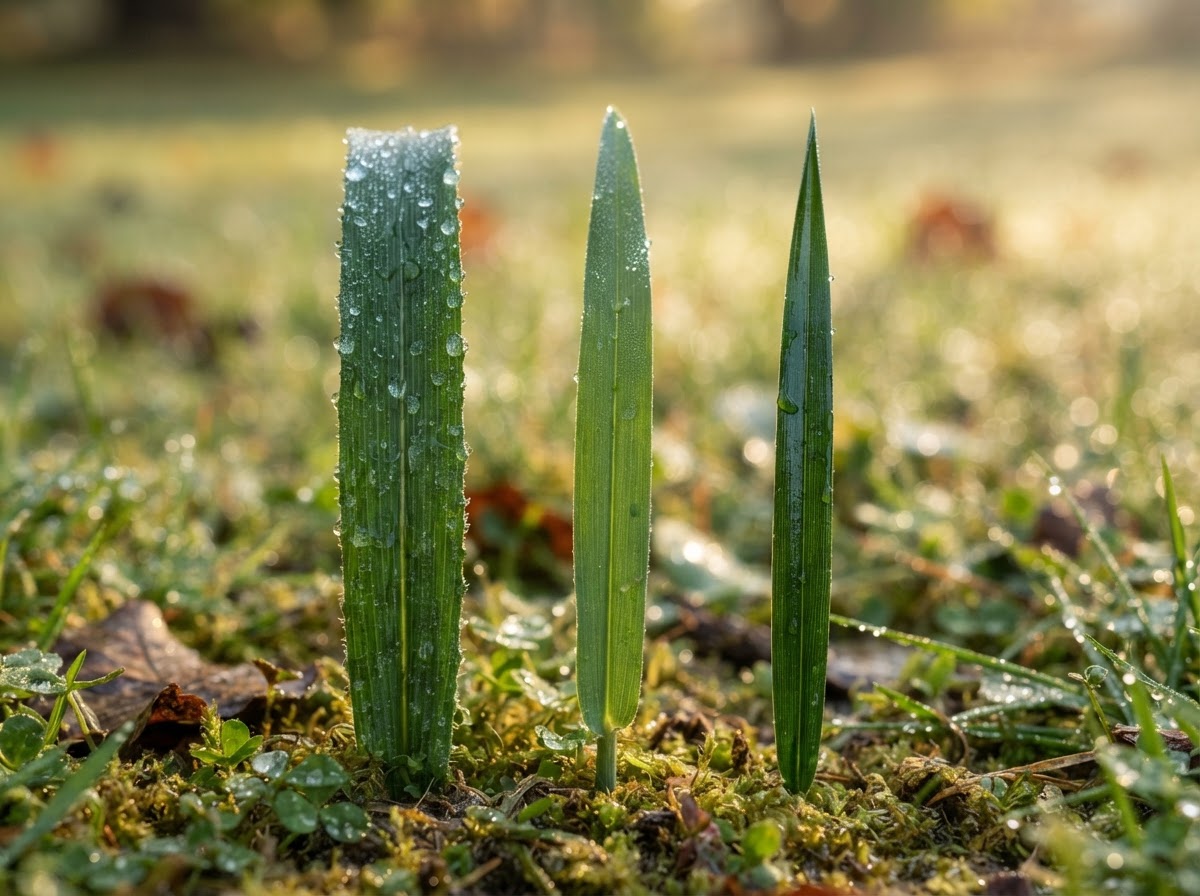
That is something I want homeowners to think about before buying seed — or hiring someone to spread it. I understand the excitement of seeing new grass. You aerate, seed, water, and then walk outside looking for those first little green shoots. When they appear, it feels like the job worked.
But my questions go further. What grass did we establish? Does it fit this property? How will we maintain it? And did we give it enough time to develop before the season changed?
Those questions become especially important when September starts slipping into October. Over the years, I have had homeowners who wanted aeration and overseeding after our preferred window was getting tight. One longstanding industry approach has been to include perennial ryegrass because it establishes quickly. There can be a place for that. But I do not want a quick green-up to become a substitute for choosing the right lawn.
I want you pleased with the grass next summer — not just excited about the first sprouts this fall.
The Quick Answer
The grass that comes up first is not necessarily the grass you wanted to live with for the next ten years.
For many suitable Eastern Pennsylvania lawns, my starting preference is a mixture built around turf-type tall fescue with a smaller Kentucky bluegrass component — planted early enough to establish. Perennial ryegrass can be useful when speed matters, but it should be included deliberately, not automatically added because the calendar says October.
Which Grass Would I Choose for a Pennsylvania Lawn?
For many suitable Eastern Pennsylvania lawns, my starting preference is a mixture built around turf-type tall fescue with a smaller Kentucky bluegrass component, planted early enough to establish. That is the approach behind Golden Green’s Sunny Seed Mix.
Perennial ryegrass can also be useful, particularly when rapid establishment is an important part of the job. But it should be included deliberately — not automatically added to every lawn because the calendar says October. These grasses bring different strengths. Tall fescue offers useful drought tolerance, Kentucky bluegrass spreads through underground stems, and perennial ryegrass establishes rapidly. The appropriate combination depends on the property and the maintenance it will receive.
Before choosing, I want to understand the existing grass, sunlight, soil, traffic, watering capability, and time remaining in the growing season.
Three Grasses, Three Different Strengths
Each card keeps its strength and limitation visible. No grass is labeled “best overall” — the right choice depends on the property and the maintenance it will receive.
Turf-type Tall Fescue
Strength
Drought tolerance from deeper rooting; good traffic tolerance; improved leaf texture vs. older forage types.
Limitation
Primarily bunch-type growth — does not spread back into bare openings. Still needs establishment watering.
Owner’s take: A useful foundation for a durable home lawn — but we still have to build the conditions around it.
Kentucky Bluegrass
Strength
Underground rhizomes let it spread and help fill small openings — an edge over bunch grasses.
Limitation
Slower to establish from seed; takes longer to mature before the season changes.
Owner’s take: I like what it contributes, but I do not want to run out of establishment time while waiting for it.
Perennial Ryegrass
Strength
Rapid establishment when getting grass down quickly matters; good wear tolerance.
Limitation
Grows in bunches, not an extensive rhizome system; can become disproportionately prominent in a mixture.
Owner’s take: I respect it as a tool — I just want to know why we are using it and whether it belongs in the lawn you want.
Sources: Iowa State describes improvements in leaf texture and density, plus good drought and traffic tolerance. · Penn State distinguishes Kentucky bluegrass's rhizomatous growth from the bunch-type habits of ryegrass and tall fescue. · Rutgers notes that even a small ryegrass addition can become disproportionately prominent in a tall fescue mixture.
How Quickly Do These Grasses Germinate?
Here are useful reference ranges — not a countdown clock for every lawn. Temperature, moisture, seed quality, and site conditions can change the result; cool autumn conditions can extend the wait. That is why your observation might be, “The ryegrass appeared in a week,” while another homeowner sees slower progress. And in a mixture, the first visible grass may not represent every species that was planted.
How Quickly Do These Grasses Germinate?
Useful reference ranges — not a countdown clock for every lawn. Temperature, moisture, seed quality, and site conditions can change the result.
Usually the quickest starter of these three.
Can establish reasonably quickly without ryegrass.
Needs more patience and establishment time.
Ranges consistent with University of Maryland Extension turfgrass guidance. In a mixture, the first visible grass may not represent every species planted.
Germination is the beginning — not the finish line
Penn State explains that germination leads to a seedling: the emerging plant still has further growth and development ahead of it. That matters in October. Seeing green does not automatically mean the lawn is established, well rooted, or ready for heavy use.
A green sprout is evidence that a seed started growing. It is not proof that the whole job is finished.
Why I Like Tall Fescue With Some Kentucky Bluegrass
For a suitable lawn, I like the idea of combining grasses with different useful characteristics rather than asking one grass to do everything. When I describe a tall-fescue-dominant mixture, an example would be approximately 90–95% turf-type tall fescue and 5–10% Kentucky bluegrass by seed weight. That is an example of the mixture style I am discussing — not a claim that every property needs that ratio or that every supplied seed lot has identical proportions. Confirm the actual cultivars and percentages on the seed tag. Iowa State describes that general mixture range as an option for tall fescue lawns.
For me, the question is not simply, “Does the bag contain good grass?” It is: does this combination make sense for the lawn we are improving? A sunny backyard, a partly shaded front lawn, and a heavily used side passage may call for different decisions.
What “90% Tall Fescue” Actually Means
This is a detail worth knowing before comparing seed bags. Seed-mixture percentages are expressed by weight. They do not describe the percentage of the finished lawn. Kentucky bluegrass seeds are much smaller than tall fescue seeds. Rutgers explains that a mixture containing 90% tall fescue and 10% Kentucky bluegrass by weight can contain approximately equal numbers of their seeds. Actual counts vary with the seed involved. So a relatively small bluegrass percentage is not necessarily an insignificant addition.
What “90% Tall Fescue” Actually Means
Seed-mixture percentages are expressed by weight. They do not describe the percentage of the finished lawn. Kentucky bluegrass seeds are much smaller than tall fescue seeds.
Kentucky bluegrass seeds are much smaller than tall fescue seeds. Rutgers explains a 90/10 mix by weight can contain roughly equal numbers of their seeds. By weight is not the same as the finished-lawn proportion.
For illustration, a hypothetical 50-pound mixture at 90/10 would contain 45 pounds of tall fescue seed and five pounds of Kentucky bluegrass seed. It would not guarantee a finished lawn that is exactly 90% tall fescue and 10% bluegrass. That is another reason I want homeowners looking beyond the large words printed on the front of a bag.
What My Macungie Lawn Taught Me
I have described my former lawn in Macungie because it shaped how I think about this work. It was an established lawn. I could fertilize it, water it, and improve the color. But it still was not developing into the lawn I wanted. Over four consecutive falls, I aerated and seeded while continuing the broader maintenance program. Over time, the lawn changed considerably.
I am not presenting my yard as a controlled experiment or claiming seed alone caused every improvement. It was one lawn, under its own conditions, receiving several kinds of care. But the experience reinforced a distinction I still make with homeowners: feeding an existing lawn and changing its grass population are not the same job. That is why seed selection matters to me. I do not want to spend several falls introducing a grass simply because it came up quickly the first week. I want the selection connected to the long-term plan.
Newer Grass Varieties: What Has Actually Improved?
Modern turfgrass breeding has produced useful improvements in characteristics such as leaf texture, color, density, and resistance to particular diseases. Rutgers describes those advances across tall fescue, Kentucky bluegrass, and perennial ryegrass. But “newer” is not a guarantee that every characteristic improved equally.
When I discuss improved turfgrass varieties, or cultivars, I am referring to selected varieties with particular characteristics — not making a claim that Sunny Seed Mix has been genetically engineered. Nor would I assume that a newer Kentucky bluegrass automatically germinates as quickly as perennial ryegrass. Tall fescue itself can emerge quickly under favorable conditions; Iowa State reports a five-to-ten-day germination range in its tall fescue guidance.
We do not need to add ryegrass merely because we assume tall fescue cannot get started promptly. We should consider the actual seed, conditions, and purpose of the job.
How My Seed Conversation Changes as Fall Progresses
Penn State identifies late summer as the optimum seeding period in most of Pennsylvania. Warm soil and the opportunity for fall and spring growth give seedlings advantages over a spring start followed quickly by summer stress. For Golden Green, I use that guidance alongside what I am seeing on the property.
How My Seed Conversation Changes as Fall Progresses
A planning framework — not a fixed schedule or a guarantee for every Eastern Pennsylvania lawn.
Warm soil plus time for fall and spring growth. Select grass for the long-term lawn; use the earlier part of the window when practical.
Still workable, but not equivalent to starting several weeks earlier. Recheck species, soil, and time remaining.
Faster establishment may matter — but so does explaining the risk and the resulting grass composition.
A warm afternoon does not make immediate seeding worthwhile. Consider postponement or a different establishment approach.
Purdue warns that even within a recommended regional period, waiting an extra week can mean considerably less time for the turf to mature. Later days are not necessarily as productive as earlier ones.
Why I prefer not to give away the early weeks
Purdue’s establishment guidance warns that even within a recommended regional seeding period, waiting an additional week can mean considerably more time for the turf to mature as the season progresses. Its calendar recommendations are for Indiana and Illinois, but the underlying lesson is relevant here: later days are not necessarily as productive as earlier ones. That is why I would not encourage a homeowner to wait until October simply because we may have an option then.
Why Lawn Companies Have Used Perennial Ryegrass for Later Jobs
Here is the situation I have encountered. A homeowner gets busy. September passes. Then they call and really want the lawn aerated and seeded. I understand. They are looking at thin grass, and they want to do something before winter. Historically, one way lawn professionals have approached a later job is to include perennial ryegrass because of its rapid establishment.
There is a regional agronomic basis for that thinking. In a fall advisory, Rutgers described how cooling soils slow establishment and identified perennial ryegrass as a later-season option after the advisable window for other grasses narrowed. That advisory described New Jersey conditions at the time; it was not a permanent cutoff date for every Pennsylvania property. So yes, perennial ryegrass may belong in the discussion. But I want the discussion to include the next question: are we still building the lawn the homeowner originally wanted?
Why I Would Not Automatically Add Ryegrass Every October
Perennial ryegrass establishes aggressively. That can help with initial cover, but it can also change the balance of a mixture. Rutgers cautions that even a relatively small ryegrass addition can become disproportionately prominent in a tall fescue mixture under some establishment conditions. Its sports-turf guidance is a useful warning about competition — not a prediction that every home lawn will develop identically.
This is why I do not like the instruction, “Just put some ryegrass in.” How much? Which cultivar? What is already growing there? What is the intended result? If our goal is a predominantly tall fescue lawn with Kentucky bluegrass contributing to it, we should not casually change that plan merely to produce faster-looking results.
The seed should solve the homeowner’s problem — not just make the contractor’s schedule easier.
Sometimes a carefully chosen ryegrass-inclusive mixture is reasonable. Sometimes it is better to explain that the original plan needs a more favorable planting opportunity. Both can be honest recommendations.
A Warm November Is Possible. It Is Not Something I Can Promise.
Some falls cooperate beautifully. Others close down much sooner. I do not want a homeowner thinking we can make a risky date safe by assuming several more warm weeks will arrive. Penn State notes that sufficiently cold soil prevents germination and that the time of establishment needs to account for seasonal conditions. An air-temperature forecast is useful, but I also want to consider the seedbed, moisture, existing turf, and how much establishment remains.
Faster seed gives us another option. It does not give us control over winter.
Sometimes “Not This Week” Is the Right Recommendation
If a homeowner is determined to seed late, I still owe them a recommendation that fits the property. Depending on the situation, we might discuss proceeding with adjusted expectations, postponing the work, or considering another establishment approach. Dormant seeding and spring seeding are different strategies — not simply ordinary fall overseeding performed later. Purdue discusses them as alternatives with their own requirements and risks. I would rather explain those options before taking the homeowner’s money. The service is not complete merely because we ran the aerator, spread the seed, and sent an invoice. The homeowner hired us to improve the lawn.
Choosing Grass Means Looking Beyond Germination
Speed matters, but I also want to know what the homeowner expects afterward.
Choosing Grass Means Looking Beyond Germination
What will summer look like?
Tall fescue's drought tolerance can be useful; Kentucky bluegrass may respond to prolonged heat and dryness by entering dormancy. Neither is a promise of uninterrupted green regardless of weather or care.
What happens when the lawn wears thin?
Wear tolerance and recovery are different characteristics. A grass can tolerate use well but have limited ability to spread back into a bare opening.
How much shade is there?
None of these three grasses is a solution for every shaded backyard. Some sites call for fine fescues or an alternative to turf.
Can the lawn be maintained consistently?
Mowing height, sharp blades, and suitable watering still matter after the new grass appears. The best seed choice is one the property can support and the homeowner can realistically maintain.
Read the Seed Tag Before the Marketing Claims
The front of the bag gets your attention. The seed tag helps explain what you are buying. Also, perennial ryegrass is not annual ryegrass. For this discussion, I mean turf-type perennial ryegrass intended for a continuing lawn. Annual ryegrass is a different plant and should not be casually substituted because the names sound similar. At Golden Green, I want the seed conversation to be specific. “Premium seed” should lead to an explanation — not end the conversation.
Read the Seed Tag Before the Marketing Claims
The front of the bag gets your attention. The seed tag helps explain what you are buying. Look for:
- Species and named cultivars
- Proportions by weight
- Germination information
- Test date
- Amounts of weed seed, other crop seed, and inert material
- Perennial ryegrass — not annual ryegrass
Perennial ryegrass is not annual ryegrass. For this discussion, we mean turf-type perennial ryegrass intended for a continuing lawn.
Even Excellent Seed Needs Somewhere to Grow
This is why seed choice and professional overseeding belong together. I want to understand why the lawn became thin before deciding what to put into it. Perhaps mechanical core aeration is appropriate. Perhaps the area needs a different type of preparation. Significant drainage or shade limitations need their own plan. We also need seed-to-soil contact, appropriate moisture, and a review of products recently applied to the lawn. Penn State’s establishment guidance emphasizes evaluating the site and planning the work before seeding.
Do not stop caring for the mixture when the first grass appears
A mixture can contain seedlings at different stages. Seeing the quickest grass emerge does not mean it is time to abandon the establishment plan for everything else. Purdue recommends managing moisture carefully during establishment and adjusting irrigation as the new turf develops. Its guidance also emphasizes coordinating weed-control products with newly seeded turf and following the relevant labels. We can select seed and prepare the lawn. The work after application still matters.
Which Situation Sounds Like Your Lawn?
These are different situations. They should not receive the same automatic recommendation.
Which Situation Sounds Like Your Lawn?
A planning aid — not an automatic diagnosis or seed-mixture calculator. Click a choice to reveal its explanation.
This is the conversation I prefer. We can evaluate the property, select the appropriate grass, and schedule the work with establishment time in mind. For many suitable lawns, my starting preference remains a tall-fescue-dominant mixture with Kentucky bluegrass.
What I Want You to Remember
For me, comparing Kentucky bluegrass vs. fescue vs. ryegrass is not about announcing one winner for every Pennsylvania lawn. It is about making a deliberate choice. What lawn are we trying to build? What is growing there already? What conditions will the new plants face? And have we left enough time for them to establish?
I like turf-type tall fescue and Kentucky bluegrass for many of the lawns we are trying to improve. I also recognize why perennial ryegrass has been useful in the industry, especially when establishment speed matters. But I do not want speed to become the entire decision.
A good seeding job should make sense on the day we apply it — and in the seasons that follow.
That is what excites me about this work. Not just seeing the first green shoots. Seeing a homeowner walk onto the lawn later and realize it is becoming the lawn they hoped for.
Golden Green — Your Lawn’s Best Friend.
Not Sure Which Grass Your Lawn Needs?
Start with your property, your concerns, and your goals. Golden Green can help explain the appropriate next steps for an overseeding plan — and a quote based on the lawn you actually have.
Get Help Choosing Seed for Your Lawn
Not sure whether your lawn needs tall fescue, Kentucky bluegrass, perennial ryegrass, or a different approach? Start with your property, your concerns, and your goals. Golden Green can help explain the appropriate next steps for an overseeding plan.
Keep Reading About Grass Seed & Overseeding
These related pages go deeper on the services and reasoning behind grass selection:
Sunny’s Seed Mix
A tall-fescue-dominant mixture with a Kentucky bluegrass component — the approach behind Golden Green’s seed selection.
Professional Overseeding
Even excellent seed needs somewhere to grow. Seed choice and overseeding belong together.
Kentucky Bluegrass vs. Tall Fescue
The more detailed two-grass comparison for Eastern Pennsylvania lawns.
Mechanical Core Aeration
Create openings in the soil and give new grass a practical opportunity to establish.
University Citations Behind This Article
Iowa State — tall fescue improvements
Improved turf-type tall fescue leaf texture, density, and drought/traffic tolerance; 5–10 day germination range.
Penn State — turfgrass establishment & selection
Late summer is the optimum seeding period; Kentucky bluegrass rhizomatous growth vs. bunch-type ryegrass and tall fescue.
University of Maryland Extension — germination ranges
Germination time ranges consistent with 5–10 (ryegrass), 7–14 (tall fescue), and 14–21 (bluegrass) days under favorable conditions.
Rutgers — tall fescue mixtures & breeding advances
90/10 tall fescue/Kentucky bluegrass by weight can contain ~equal seed counts; small ryegrass additions can become disproportionately prominent; breeding advances in texture, color, density.
Purdue — establishment & renovation guidance
Later days are less productive than earlier ones; dormancy and spring seeding are alternatives with their own requirements.
Citations are provided as ordinary linked references. Golden Green’s field experience is separate from university recommendations.
Helpful lawn care advice for Pennsylvania homeowners
If this guide helped you, add Golden Green as a Preferred Source on Google to see more of our lawn care guides in Google Search and AI experiences.
Frequently Asked Questions About Grass Selection in Pennsylvania
Is tall fescue better than Kentucky bluegrass or perennial ryegrass?+
Not for every property. Each has useful characteristics and limitations. The choice should reflect the site, intended use, maintenance, and establishment conditions rather than a universal ranking.
Can Kentucky bluegrass and tall fescue be mixed?+
Yes. Mixtures of these species are used in turf management. The proportions should be selected deliberately, and percentages by weight should not be confused with the eventual proportions of grass in the lawn.
Does perennial ryegrass germinate in seven to ten days?+
That can happen under favorable conditions. Published guidance commonly places perennial ryegrass germination around five to ten days, but temperature and moisture can change the timeline.
Should I automatically add perennial ryegrass when seeding in October?+
No. Faster establishment may make it worth considering, but the lawn's intended composition and remaining growing conditions still matter. It is not a guarantee that late seeding will succeed.
Are newer grass varieties genetically modified?+
An "improved cultivar" does not establish that a grass was genetically engineered. In this article, the term refers to selected turfgrass varieties with particular characteristics. Rutgers describes breeding advances in texture, color, density, and other turf qualities.
Does every lawn need all three grasses?+
No. A deliberate two-species mixture, a blend of cultivars within one species, or a different selection may be more appropriate. Seed selection should match the site and use.