Lawn Fertilization: How Much Fertilizer Does Your Pennsylvania Lawn Need?
Lawn fertilization should not be guesswork. The right amount of fertilizer depends on your lawn size, the fertilizer analysis on the bag, the time of year, the condition of the turf, and Pennsylvania fertilizer regulations.
The Short Answer
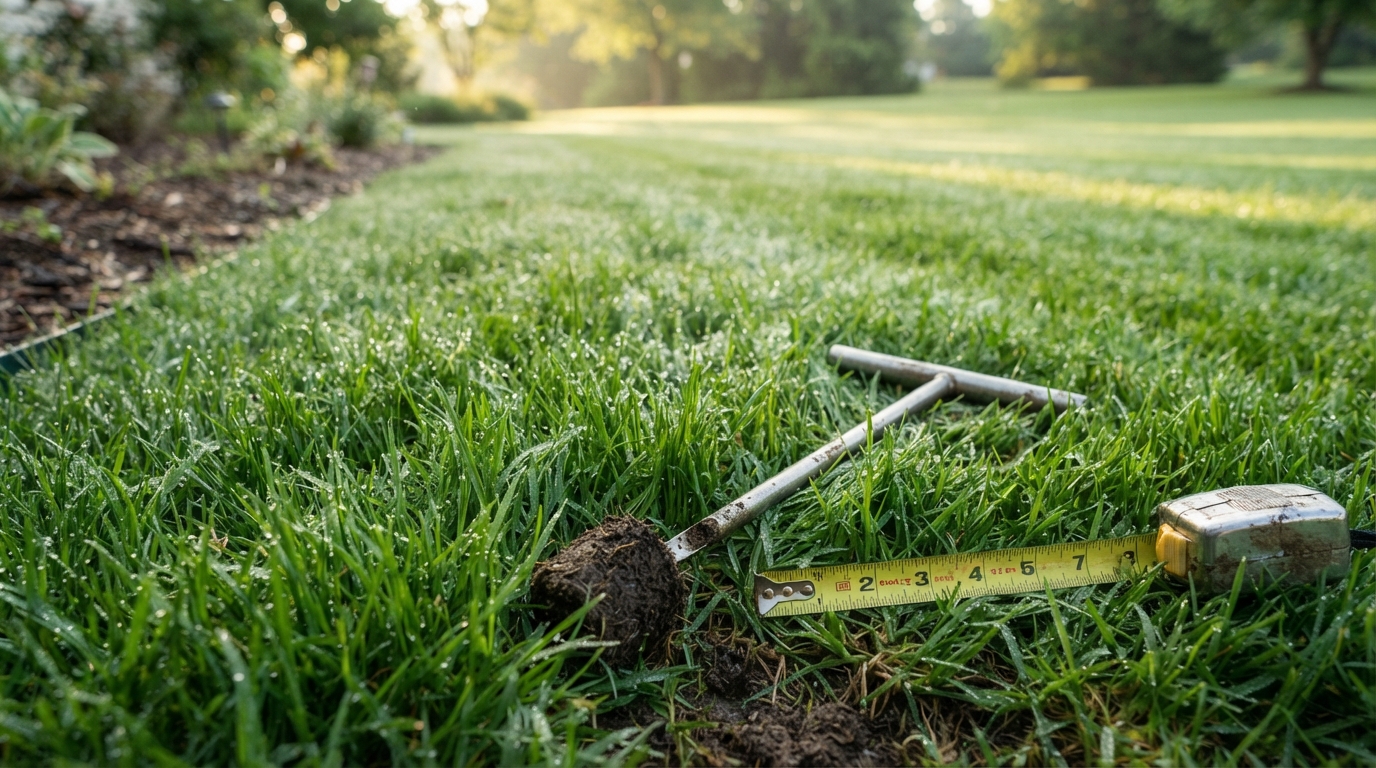
The right amount of fertilizer for your lawn depends on several factors working together — not just how big the bag is. Get the rate wrong in either direction and you either waste money or underfeed the turf.
For homeowners in the Lehigh Valley and Eastern Pennsylvania, getting the fertilizer rate right matters. Too little fertilizer may produce disappointing results. Too much can cause excessive growth, increase mowing, stress the turf, waste fertilizer, increase the risk of nutrient loss, and potentially violate Pennsylvania fertilizer requirements.
At Golden Green, we believe lawn fertilization should be measured, planned, and explained—not guessed. If you'd rather skip the math, our professional lawn fertilization service handles every calculation for you.
What Is Lawn Fertilization?
Lawn fertilization is the process of supplying turfgrass with nutrients it needs for healthy growth, color, density, root development, stress tolerance, and recovery. For most established lawns, nitrogen receives much of the attention because turfgrass uses relatively large amounts of it.
But good lawn fertilization isn't simply about making grass turn dark green. A properly managed fertilization program should help develop a lawn that is thicker, more uniform, better able to recover from stress, better able to compete with weeds, and supported through Pennsylvania's changing seasons.
Thicker turf
More uniform growth
Better stress recovery
Competes with weeds
Deeper root development
Season-long support
Fertilizer is one part of building a healthy lawn. Soil conditions, grass varieties, mowing, watering, compaction, insects, weeds, disease, aeration, and overseeding all matter too.
What Do the Numbers on a Fertilizer Bag Mean?
Every fertilizer bag carries three numbers called the fertilizer analysis. You might see something such as 26-0-10. Those numbers represent the percentages, by weight, of nitrogen, phosphate, and potash.
Breaking Down a 26-0-10 Fertilizer Bag
Drives green growth & density
Restricted on established PA lawns
Supports stress tolerance & roots
The first number — nitrogen — is especially important when calculating lawn fertilization rates.
Why Are We Using 26-0-10 Instead of 26-5-10?
Pennsylvania has specific requirements governing fertilizer applied to turf. For established turf, fertilizer generally must contain zero phosphorus unless an exception applies, such as establishing or repairing turf or when a qualifying soil analysis indicates a need. That means fertilizer selection should not simply be based on whatever bag happens to be available at the store. The product should match both the needs of the lawn and Pennsylvania requirements.
The Most Important Lawn Fertilization Question
Many homeowners start with "How many bags of fertilizer do I need?" — but that's not really the first question. The better question is "How much actual nitrogen am I applying per 1,000 square feet?"
The Wrong Question
"How many bags do I need?"
Two 50-pound bags can contain dramatically different amounts of nitrogen. Bag size alone tells you almost nothing useful.
The Right Question
"How much nitrogen per 1,000 sq. ft.?"
A 50-lb bag at 10% nitrogen feeds a lawn very differently than a 50-lb bag at 26% nitrogen. The analysis changes everything.
How Lawn Fertilization Rates Are Calculated
The basic fertilizer calculation is simple once you know it:
Desired nitrogen rate ÷ nitrogen percentage = pounds of fertilizer product required per 1,000 sq. ft.
The nitrogen percentage must first be converted into decimal form: 10% becomes 0.10, 20% becomes 0.20, 26% becomes 0.26, and 30% becomes 0.30.
Example: Applying 0.7 Pound of Nitrogen
Suppose a fertilizer contains 26% nitrogen and the planned application is designed to deliver 0.7 pound of nitrogen per 1,000 square feet. Here's how the math breaks down step by step:
Set your nitrogen target
0.7 lb of actual nitrogen per 1,000 sq. ft.
Convert the nitrogen percentage to a decimal
26% nitrogen → 0.26
Divide the target by the decimal
0.7 ÷ 0.26 = 2.69
The result is your product rate
≈ 2.7 lb of 26% fertilizer per 1,000 sq. ft.
That is very different from simply looking at the size of the bag.
Important:This example explains the mathematics. The appropriate application rate depends on the fertilizer label, nitrogen availability, lawn conditions, timing, soil-test recommendations when applicable, and Pennsylvania regulations.
Pennsylvania Lawn Fertilization Has Specific Rules
This is something Pennsylvania homeowners should understand. Pennsylvania limits the amount of nitrogen that can be applied to turf in a single application.
Readily Available Nitrogen
0.7 lb
per 1,000 sq. ft. per application
Total Nitrogen
0.9 lb
per 1,000 sq. ft. per application
Pennsylvania also generally restricts phosphorus applications to established turf unless certain exceptions apply. Those rules are one reason professional lawn fertilization involves more than putting fertilizer into a spreader and walking across a lawn. You need to understand:
How Much Area Does One Bag of Fertilizer Cover?
Now let's make the calculation practical. Suppose we have a 50-pound bag of 26-0-10 and our example application uses approximately 2.69 pounds of fertilizer per 1,000 sq. ft.
Divide the bag weight by the application rate: 50 ÷ 2.69 = 18.6. That means one 50-pound bag covers roughly 18,600 square feet at that example rate.
One 50-lb Bag of 26-0-10 Covers…
Change the nitrogen rate or fertilizer analysis and the coverage changes too. "One bag covers X square feet" only makes sense when you also know the intended application rate.
How Much Fertilizer Does a 30,000-Square-Foot Lawn Need?
Using the same example, suppose the actual turf area is 30,000 square feet. If one bag covers approximately 18,600 square feet: 30,000 ÷ 18,600 = 1.61. The lawn would require approximately 1.6 bags of that fertilizer at that particular example rate.
But real-world lawn fertilization requires more than one calculation. A technician must also account for:
Doing the math is important. Applying it accurately on an actual property is where professional lawn care begins.
Why Accurate Lawn Measurements Matter
You cannot accurately fertilize a lawn when you don't know how big it is.
A homeowner might estimate that a lawn contains 10,000 square feet of turf when the actual treatment area is 7,800 square feet. Or it might really be 12,400. That difference matters.
Guess 10,000 sq. ft. — Actual 7,800 sq. ft.
Lawn receives too much product → excessive growth, wasted fertilizer, potential runoff.
Guess 10,000 sq. ft. — Actual 12,400 sq. ft.
Lawn receives too little product → weak response, inconsistent color, uneven turf.
Golden Green believes lawn treatments should be based on actual serviceable turf area rather than rough guesses.
Why Spreader Calibration Matters
Even the correct fertilizer calculation won't help if the equipment is applying the wrong amount. A fertilizer spreader needs to be calibrated so the amount being discharged matches the intended application rate. Several factors can change the amount of fertilizer actually reaching the turf:
That's why the setting printed on a fertilizer bag is not the entire story. Professional lawn fertilization combines the correct product rate with properly calibrated application equipment.
More Fertilizer Is Not Better
One of the easiest mistakes to make with lawn fertilizer is assuming "If some is good, more must be better." Grass doesn't work that way.
What Excessive Fertilization Causes
The goal isn't to push the lawn as hard as possible. The goal is to give the turf the right amount of nutrition at the right time.
Why Lawn Fertilization Timing Matters in Pennsylvania
Eastern Pennsylvania is predominantly cool-season turf country. Common lawn grasses include Kentucky bluegrass and turf-type tall fescue. These grasses generally perform best during the cooler growing conditions of spring and fall and experience greater environmental stress during hot Pennsylvania summers. That means a good lawn fertilization program should change with the season.
Spring
Supports green-up and turf development as the lawn resumes active growth. Also an important period for weed-prevention strategies.
Late Spring
Supports the lawn without creating excessive growth heading into summer stress.
Summer
Hot weather and drought place cool-season lawns under significant stress. Account for temperature, moisture, and fertilizer characteristics.
Early Fall
One of the most important recovery periods. Temperatures moderate, root activity increases, and summer-damaged lawns recover. Prime time to combine fertilization with core aeration and overseeding.
Late Fall
Late-season nutrition can be part of a cool-season program, but timing and application rates still matter. More is never automatically better because winter is approaching.
Fertilizer Should Stay on the Lawn
Proper lawn fertilization also means keeping fertilizer where it belongs.
Fertilizer granules should not be left on sidewalks, driveways, roads, patios, or other impervious surfaces. Pennsylvania law contains requirements designed to help prevent fertilizer from entering waterways and drainage systems. That makes careful application around edges, pavement, storm drains, streams, ponds, and drainage areas especially important.
Good lawn care isn't just about what goes onto the property. It is also about where the product does not go.
Lawn Fertilization and Soil Testing
Another common misconception is that every lawn needs the same fertilizer. It doesn't. Soil chemistry varies from property to property. A soil test can provide information about conditions such as soil pH, phosphorus, potassium, and nutrient recommendations.
For example, repeatedly adding lime without knowing the soil pH is not necessarily beneficial. Likewise, adding nutrients a lawn doesn't need doesn't improve the lawn simply because they're fertilizer. Golden Green offers soil testing because sometimes the best lawn-care decision begins with finding out what is happening underneath the grass.
Fertilizer Alone Cannot Fix Every Lawn
A green lawn is not necessarily a healthy lawn, and fertilizer cannot solve every turf problem. A thin or struggling lawn could be suffering from:
Adding more fertilizer without identifying the underlying issue can miss the real problem. Sometimes a lawn needs nutrition. Sometimes it needs aeration. Sometimes it needs seed. Sometimes it needs lime. Sometimes it needs weed control. And sometimes the first thing it needs is a better diagnosis.
What Should Homeowners Expect From Lawn Fertilization?
Healthy lawns are built over time.
After One Fertilizer Application
Depending on the product, weather, soil moisture, temperature, and condition of the grass, homeowners may notice improved color and growth. But one application cannot rebuild a severely neglected lawn.
During the First Season
Consistent lawn fertilization and weed control can begin creating more uniform color and improved turf density. Weak or thin areas may still require aeration and overseeding.
Over Multiple Seasons
A consistent program can help build a lawn with better density, color, root development, recovery, stress tolerance, and overall appearance.
The strongest results usually come when fertilization is combined with good mowing, proper watering, weed management, soil management, aeration when needed, and quality grass seed. A premium lawn isn't simply fed. It's built.
How Golden Green Approaches Lawn Fertilization
At Golden Green, our goal isn't simply to make your lawn green for a few weeks. We want to help build a thicker, healthier, more attractive lawn over time.
That means paying attention to lawn square footage, fertilizer analysis, application rates, product labels, equipment calibration, seasonal timing, Pennsylvania fertilizer requirements, soil conditions, weed pressure, turf density, and the condition of the lawn after each treatment. Lawn fertilization should have a reason behind it. You should know what is being applied, why it is being applied, and what we're trying to accomplish. That's part of being Your Lawn's Best Friend.
Need Lawn Fertilization in Eastern Pennsylvania?
If you'd rather not calculate fertilizer rates, measure thousands of square feet, calibrate a spreader, store fertilizer, and figure out what your lawn needs throughout the season, Golden Green can take care of it. Our lawn care programs are designed for cool-season lawns throughout the Lehigh Valley and Eastern Pennsylvania. We can help determine whether your lawn needs lawn fertilization, weed control, grub prevention, soil testing, lime, core aeration, overseeding, or other corrective lawn care.
Stop Guessing. Start Measuring.
Let Golden Green calculate the right fertilizer rate, choose the right product, and apply it at the right time for your Eastern Pennsylvania lawn.
Golden Green — Your Lawn's Best Friend.
Frequently Asked Questions About Lawn Fertilization
1How do I know how much fertilizer my lawn needs?
2What do the three numbers on lawn fertilizer mean?
3How much fertilizer should be applied per 1,000 square feet?
4Can too much fertilizer hurt grass?
5How often should a Pennsylvania lawn be fertilized?
6Is fall a good time for lawn fertilization in Pennsylvania?
7Does my lawn need phosphorus?
8Is fertilizer enough to make a lawn thick?
9Does Golden Green provide lawn fertilization near me?
Related Articles
Lawn Care Services in Lehigh Valley, PA: Complete Homeowner's Guide
Looking for lawn care services in Lehigh Valley, PA? Learn about fertilization, weed control, aeration, overseeding, grub control, lime and seasonal lawn care.
Read Article
Best Lawn Fertilizer in Pennsylvania: What Works for PA Lawns
Discover the best lawn fertilizer for Pennsylvania lawns. Learn about NPK ratios, slow-release vs quick-release, organic-based options, and seasonal fertilization strategies.
Read Article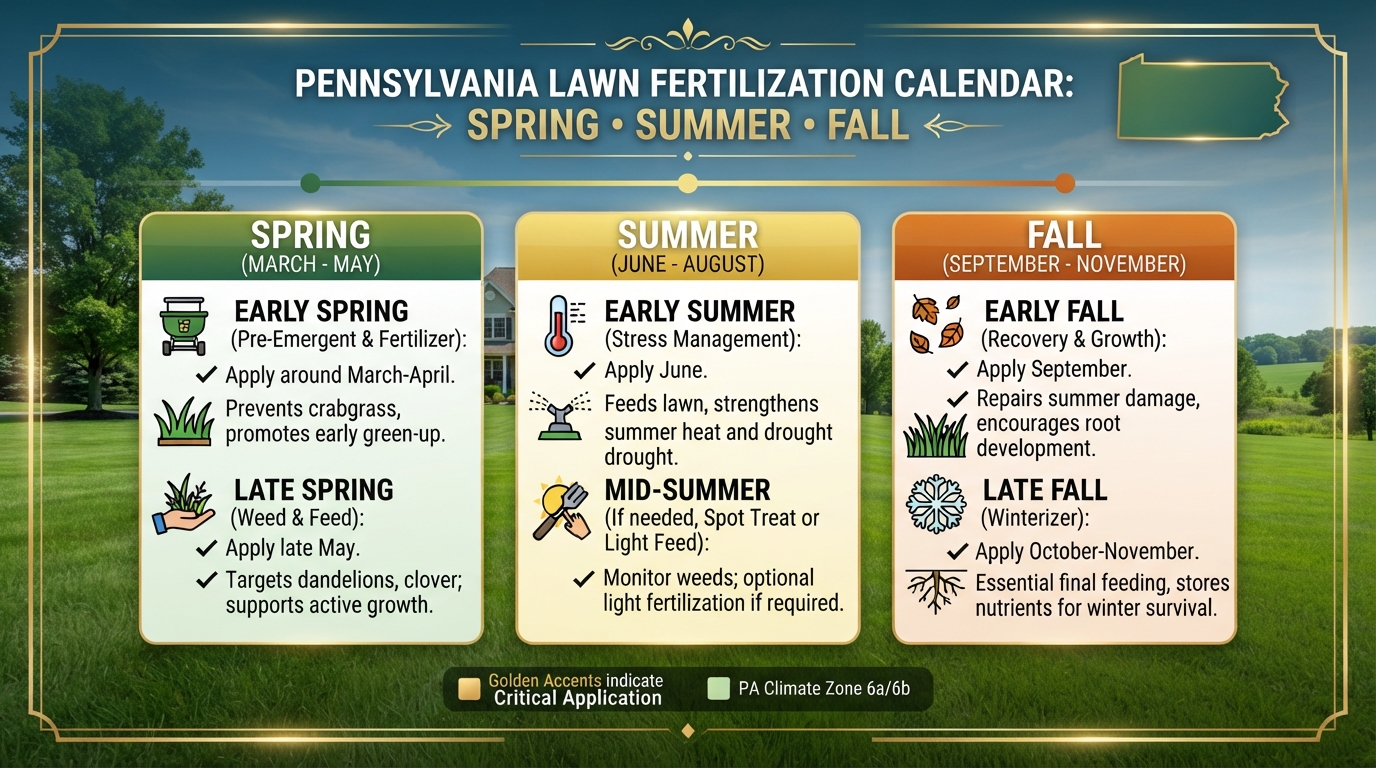
When to Fertilize Lawns in PA: Seasonal Timing Guide
Learn exactly when to fertilize your Pennsylvania lawn throughout the year, with a month-by-month breakdown for cool-season grasses.
Read ArticleGolden Green Lawn Care Services