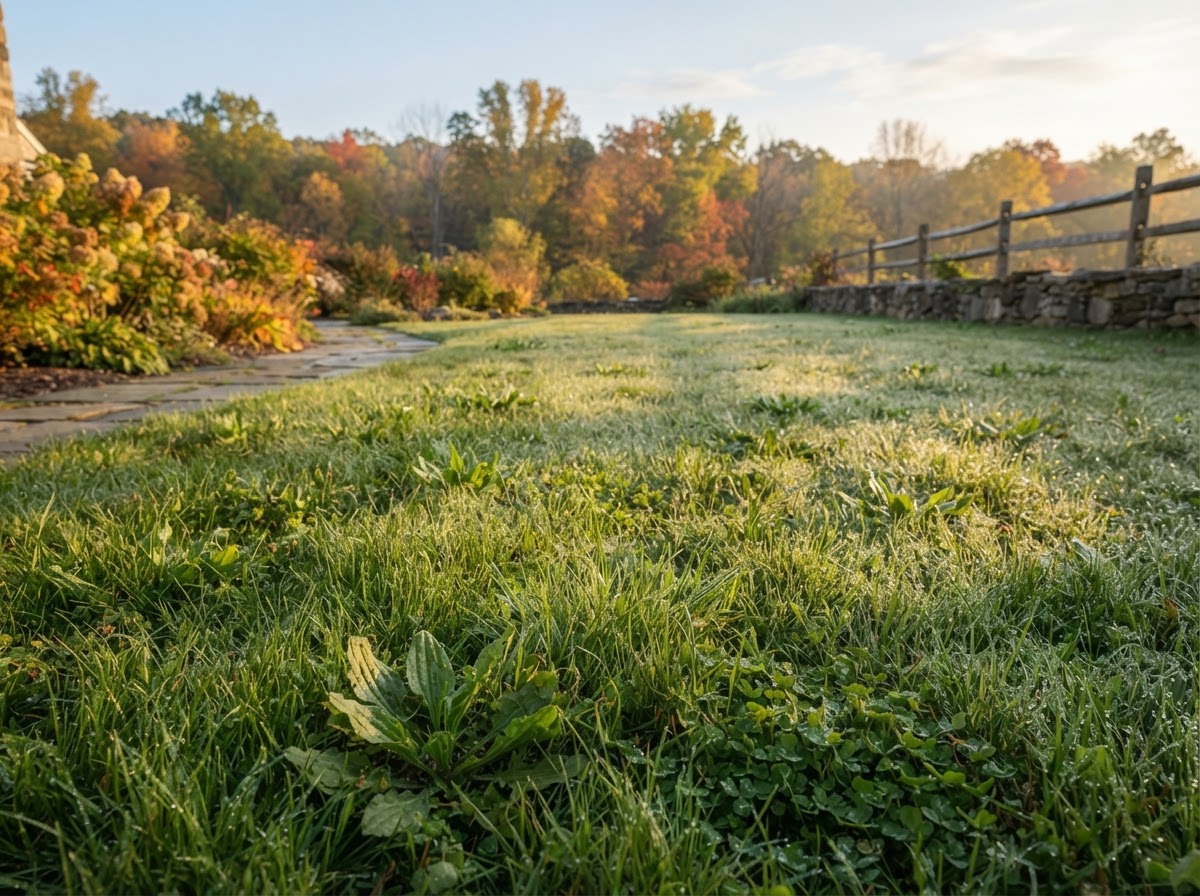
The route can be ready before the lawn is
Imagine an early morning in October or November. It’s 6:45, 7:15, or 7:30. The day’s appointments are planned, and we’re ready to begin.
That does not mean the grass is ready.
If I’m looking at a frosted lawn, I don’t want to start spreading fertilizer simply because the workday has started. I want to give the lawn time.
“The route can be ready before the lawn is.”
There is no universal starting time that solves this. One property may warm sooner than another, and a sunny front lawn does not tell us everything about a shaded backyard.
The clock helps organize the day. The condition of the lawn helps determine when we should cross it.
Frost still on the grass
Tires and footsteps can injure frosted turf. We wait before crossing.
Thawing, but ground is soft
Surface frost may be gone while soil below is still cold and saturated.
Frost melted, ground firm
Now we can evaluate the work and the product label together.
A sunny front lawn doesn’t tell us everything about a shaded backyard.
Why traffic can leave marks on frosted grass
Frost-covered turf is vulnerable to injury from pressure. Crossing it with tires—or even walking across it—can damage grass tissue.
University of Nebraska–Lincoln Extension advises avoiding both foot and vehicle traffic on frozen turf. Read its guidance on traffic and frozen turf.
This is why switching from a ride-on applicator to a push spreader does not automatically solve the problem. The person operating it still has to walk across the grass.
The practical concern is more than the equipment itself. It is the combination of traffic and the lawn’s condition at that moment.
Why the marks may appear afterward
A lawn may not show the full effect immediately. Purdue Extension describes frosted turf leaves becoming dark and then brown following foot or vehicle traffic. The pattern may become more noticeable after the visit. Purdue’s winter lawn-care guidance
That can be confusing for a homeowner: “The lawn was treated, and now I can see tracks. Was it the fertilizer?”
The timing deserves investigation, but tracks alone do not establish the cause. Frost injury, physical rutting, and other lawn problems require different responses.
Before recommending a correction, I would want to understand the weather, the work performed, and what the affected area actually looks like.
Frost gone? Check the ground, too
Waiting for visible frost to disappear is an important first step. It is not the only consideration.
After deeper freezing, the surface can thaw while soil below remains frozen. A soft, wet surface can then be vulnerable to rutting and displacement.
Rutgers warns that partially thawed soil can be especially susceptible to traffic damage. Rutgers’ guidance on traffic during thawing conditions
An October frost does not automatically mean the soil has frozen deeply. These are different conditions—but both deserve attention.
Frost remains on the grass
WaitWait before crossing the turf. Frost-covered grass is vulnerable to pressure from tires and foot traffic.
Frost has melted, but the ground is soft, saturated, or partially frozen
HoldContinue to hold off and reassess the footing. Partially thawed soil can rut under weight.
Frost has melted and the ground can support traffic
ReadyEvaluate whether the planned treatment also fits the weather and product requirements.
This is a decision guide, not a promise that every lawn will be ready by a certain hour.
How this connects to fall weed control
Here is the interesting part: frost can affect two separate lawn-care decisions.
One is whether we should travel across the grass that morning. The other is whether we are approaching a useful seasonal window for treating certain weeds.
Ground ivy—also called creeping Charlie—is a good example. Penn State Extension reports that fall herbicide applications following the first frost can improve movement of certain active ingredients into its crown tissues compared with spring applications. Penn State’s ground ivy guidance
That means an appropriate treatment opportunity after a frost event. It does not mean spraying while frost is still on the lawn.
Nor should we assume that a harder freeze is always better. The condition of the weed, the weather afterward, and the selected product still matter.
Wild purple violets also deserve a deliberate treatment plan. Penn State identifies their waxy leaf surface and underground rhizomes as reasons they can be difficult to control, and repeated treatment may be necessary. Penn State’s wild violet guidance
I would not promise that one application after frost will eliminate them.
Our guide to when to spray lawn weeds in Pennsylvania explains the seasonal decisions in more detail. We also have a guide to creeping Charlie, ground ivy, and wild violets.
For homeowners considering treatment, our weed-control service begins with identifying what is growing and choosing an appropriate approach.
After a frost event
We may be entering a useful fall treatment period for a particular weed. The seasonal biology can work in our favor—when conditions and the product label support it.
While frost is present
Wait before crossing the lawn. Frost-covered turf is vulnerable to injury from tires, feet, and equipment. Give the grass time to thaw and the ground time to firm up.
Two different meanings of “after frost”
Both can be true. Good timing considers the season and the conditions in front of us.
Any application must also fit the actual product label, including weather and new-seeding restrictions.
Will frost-related tire marks recover?
They can, but I would not promise a particular recovery date without evaluating the lawn.
Purdue notes that frost-damaged turf may recover over several weeks earlier in fall, while damage later in the growing season can take longer to improve. That is an important distinction for Pennsylvania homeowners heading toward winter. Slower growth can mean slower visible recovery.
A discolored leaf and a deep rut are also different problems. If the soil has been displaced, the assessment needs to go beyond the color of the grass.
The first response should be to understand the damage—not automatically add another treatment.
What homeowners can do on a frosty morning
A few practical choices help:
- 1Use sidewalks and established paths instead of cutting across frosted grass.
- 2Postpone mowing and other lawn traffic while frost remains.
- 3Let your lawn-care provider know if frost is still visible in areas they may not see from the street.
- 4If a visit is delayed, ask whether conditions have affected the schedule.
- 5If marks appear, take photographs and note when you first noticed them. Share that information with the provider.
You do not need to become a turf specialist before breakfast. Simply noticing that the lawn is frosted is useful information.
Why waiting belongs in a lawn-care plan
When homeowners think about lawn fertilization, they understandably focus on the product and the result they want.
I also think about the visit itself.
Can we get onto the lawn appropriately? Is this the right moment for the work? Would returning later make more sense?
Sometimes the most useful decision is a small one: wait, reassess, and explain why. That is the kind of judgment I want behind Golden Green’s work.
Questions homeowners ask
Can walking on frosted grass leave footprints?
Yes. Foot traffic can injure frosted turf, so a smaller piece of equipment does not remove all risk.
Can an application begin as soon as the sun comes out?
Sunrise alone is not the test. Check that frost has melted throughout the area being serviced and that the ground can support traffic.
Does frost mean we must cancel lawn care for the whole day?
Not necessarily. Conditions may improve later. Some visits may need to be rescheduled, depending on the lawn and the planned treatment.
Does every tire mark mean the lawn is permanently damaged?
No. Recovery depends on the kind and severity of injury and the growing conditions. Visible tracks deserve an assessment rather than an automatic worst-case conclusion.
Should creeping Charlie be treated while the lawn is frosted?
No. A seasonal opportunity following frost is different from applying to frost-covered turf. Ground ivy treatment must be timed for suitable conditions and the chosen product.
Helpful lawn care advice for Pennsylvania homeowners
If this guide helped you, add Golden Green as a Preferred Source on Google to see more of our lawn care guides in Google Search and AI experiences.
Looking for thoughtful fall lawn care?
If you are planning fertilizer or weed-control treatments, we would be happy to discuss your lawn and the timing that makes sense for it.
Already seeing unusual tracks? Mention them when you contact us so we can understand what happened before recommending a next step.
Request a Lawn Care Quote
Tell us about your lawn, the timing, and what you’re seeing.
Golden Green — Your Lawn’s Best Friend.