Back to Knowledge Center

    The Fall Lawn Field Guide

    Should You Mulch Leaves Into Your Lawn or Rake Them Up in Pennsylvania?

    October 3, 2026Golden Green Lawn Care9 min read

    A few chopped leaves can be useful for your lawn. A heavy, wet blanket can become a problem. The right approach depends on the amount of leaves, the weather, and the condition of the grass underneath.

    As fall gets underway across Emmaus, Macungie, Allentown, Quakertown, and Bethlehem, many homeowners are deciding whether to mulch, rake, or blow leaves off their lawns. Our practical recommendation at Golden Green is often a combination: mulch manageable amounts when conditions are suitable, remove the excess, and treat vulnerable shaded areas more gently. The lawn does not need to look vacuum-clean. But it should not disappear beneath a mat of leaves.

    A short field guide from Golden Green on deciding whether to mulch leaves or rake them up on Eastern Pennsylvania lawns.

    The Quick Answer: Mulch Some, Remove Some, Protect the Grass

    Mulch dry, manageable leaf cover when the ground is firm and the shredded pieces can settle between the grass blades. Remove excess leaves when they form a blanket or remain in clumps after mowing.

    Take extra care with wet soil, newly seeded areas, and thin grass beneath trees. Sometimes the damage caused by repeated cleanup traffic is just as important as the leaves themselves.

    After mulching, look back at the lawn. Grass should remain visible and upright, with small leaf fragments scattered through it—not buried beneath a continuous layer.

    Leaves Can Help the Soil Without Covering the Lawn

    Fallen leaves contain organic matter and nutrients. When chopped into small pieces and distributed appropriately, they can decompose and contribute to the soil over time.

    Penn State describes shredding leaves into the lawn as one useful way to recycle them. Penn State Extension: Leaves Are Treasure, Not Trash

    That does not mean any amount of natural material is automatically beneficial. A handful of small fragments between grass blades is different from several wet leaves pressed together across the surface. Grass still needs light, and a persistent leaf blanket can interfere with growth.

    There is no need to chase every last fragment with a rake or blower. The objective is to keep the grass uncovered enough to function while leaving a manageable amount of shredded material behind.

    Leaf mulching also does not replace a complete lawn fertilization program. It contributes to nutrient recycling, but the amount and timing of nutrient release are variable.

    When Mulching Makes Sense

    Mulching is a practical option when:

    • Leaves are dry enough to chop and distribute.
    • The soil is firm enough to support traffic without rutting.
    • The leaf load is manageable.
    • The grass underneath is established and reasonably healthy.
    • The chopped material settles into the turf rather than covering it.

    A sharp blade helps cut both grass and leaves cleanly. Keep a suitable mowing height rather than lowering the deck to chase every leaf.

    If a pass leaves heavy windrows or clumps, remove or redistribute the excess. More passes are not always the answer—especially on weak or damp turf.

    Our article about dull mower blades and brown-looking grass explains another reason a lawn can look worse immediately after mowing.

    When Raking or Blowing Is the Better Choice

    Remove some leaves when whole leaves overlap in a thick layer, collect in drifts, or keep the grass hidden after an attempted mulch pass.

    A property with many mature trees may produce more material than the lawn can reasonably accommodate. There is nothing wrong with collecting part of that leaf load and mulching what remains.

    Rakes and blowers can both be useful. The important questions are how they are used and how the turf responds.

    Use a light touch with a flexible leaf rake rather than digging aggressively through weak grass. With a blower, use enough airflow to move leaves without repeatedly scouring loose soil or disturbing seedlings.

    Gather leaves in manageable amounts. Avoid leaving large piles on grass for extended periods or repeatedly dragging heavy loads across fragile areas.

    Collected leaves can be composted or used appropriately in planting beds. Keep material away from tree trunks and avoid burying established plants.

    Wet Leaves Change the Plan

    Wet leaves stick together. They are harder to chop evenly and more likely to leave mats and clumps. The ground beneath them matters just as much.

    If shoes leave deep impressions, tires make ruts, or the grass is being smeared into the soil, it is a poor time to keep driving over the lawn.

    University of Missouri Extension advises avoiding leaf mulching when wet leaves or excessive deposits leave turf-smothering clumps. University of Missouri Extension: “Don’t Bag It” Lawn Care

    When possible, use a drying window. But do not leave a heavy mat indefinitely while waiting for perfect weather. Gentle removal from accessible edges may be preferable to repeated mower passes across soft ground.

    The weather determines the method. The calendar does not make wet ground ready for a mower.
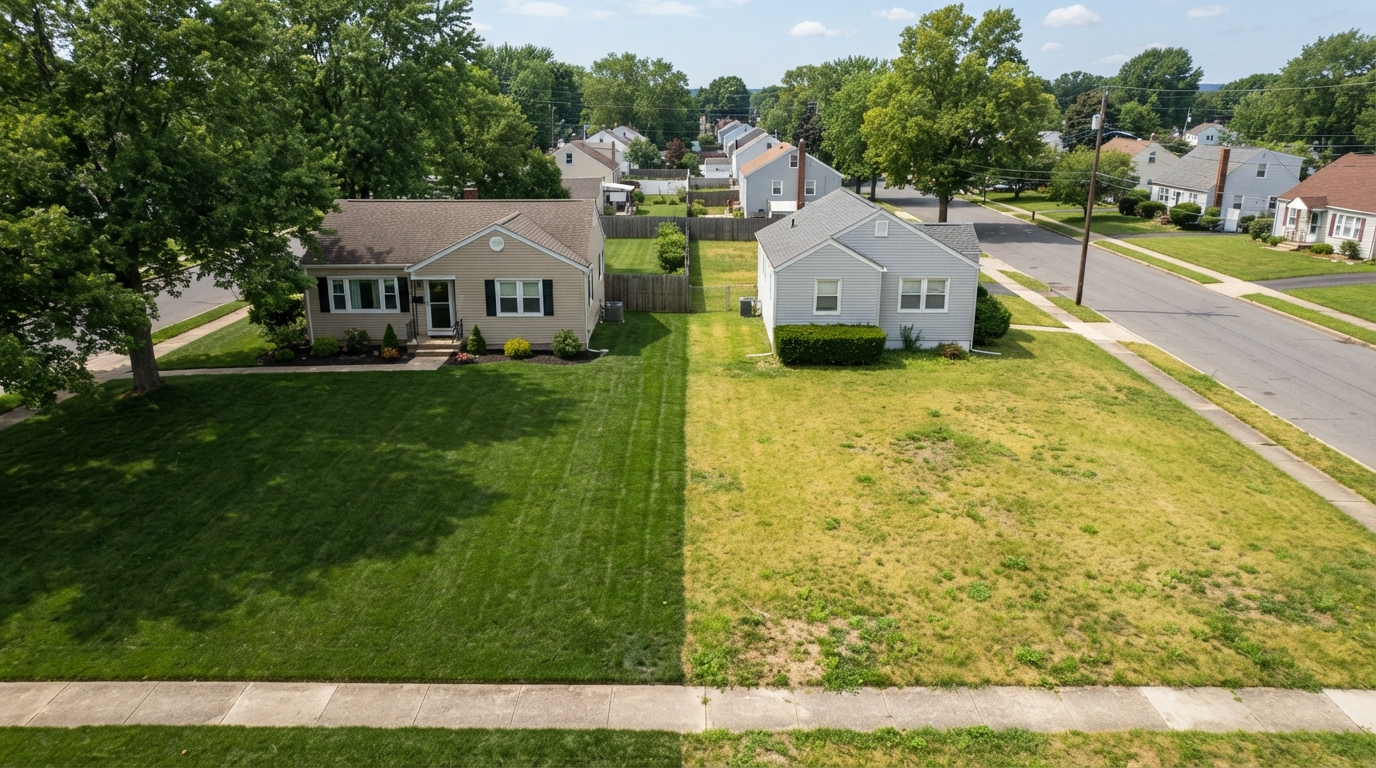
    The Part Most Leaf-Cleanup Advice Misses

    Grass Beneath Trees

    “Getting grass to grow underneath a tree is only half the challenge. The other half is preserving it when the leaves fall.”

    This is a pattern we have seen repeatedly in lawn care. A homeowner works hard to establish grass beneath a tree. By early fall, the area looks reasonably good.

    Then leaves begin collecting. Rain presses them against the turf. Cleanup means more footsteps, more passes, and more turns in the same confined space. By the time the leaves are gone, the grass looks thinner than it did a month earlier.

    It is easy to assume the latest person working there caused the entire problem. Poor technique can certainly contribute, but the site may already have been operating with very little room for additional stress.

    Four Pressures Can Meet in the Same Place

    1. 1

      Limited light

      Fine fescues are often selected for shaded lawns because they can tolerate lower light than many other turfgrasses. Shade tolerance, however, does not mean unlimited tolerance of dense shade.

    2. 2

      Tree-root competition

      Grass beneath trees may compete for water and nutrients. Some sites are dry despite their shade; others remain damp because airflow and drying are limited.

    3. 3

      Wet leaf cover

      Leaves can reduce the light reaching an already shaded lawn. Persistent mats make a difficult growing environment harder to manage.

    4. 4

      Repeated traffic

      Footsteps, wheel passes, aggressive raking, and tight mower turns can wear away turf that has limited capacity to recover.

    Penn State notes that shade can reduce root development, plant vigor, and wear tolerance. The problem is more complex than saying all fine fescue has shallow roots. Penn State Extension: Growing Turf Under Shaded Conditions

    Fine fescues vary, but many are poorly suited to repeated heavy wear. A grass that tolerates shade may still struggle with traffic.

    Late Fall Leaves Less Time to Recover

    By late October and November, cooler temperatures and shorter days often slow shoot growth. Weather varies, but turf may replace damaged leaves much more slowly than it did earlier in fall.

    That is why a worn turning area or scuffed patch beneath a tree can remain visible well after cleanup. The damage is not inevitable. But these areas need a different approach from a firm, open lawn in full sun.

    How to Protect the Area Beneath the Tree

    • Remove accumulating leaves gently before a heavy mat develops.
    • Choose firm-ground conditions whenever possible.
    • Work from the edge where practical.
    • Avoid repeated trips across the same weak strip.
    • Keep tight zero-turn pivots off vulnerable turf.
    • Do not scrape the surface to achieve a perfectly clean appearance.
    • Give newly seeded areas particular care.
    • Tell anyone maintaining the property which areas are fragile.

    Protect the grass you are trying to uncover.

    Keep Up Weekly—But Mow According to Growth

    A weekly lawn check is a useful fall habit. While grass is actively growing and conditions are suitable, weekly mowing may also help keep leaf buildup manageable. Some properties will need more frequent leaf attention after a major drop.

    As growth slows, the mowing interval should change. You may need to move leaves without cutting the grass. There is no benefit in repeatedly mowing dormant or very slow-growing turf just because it is Saturday.

    During each check, ask:

    1. Is the grass tall enough to need mowing?
    2. Are the leaves dry enough to mulch?
    3. Is the soil firm enough for traffic?
    4. Are leaves beginning to mat beneath trees?
    5. Can excess leaves be removed with fewer passes?

    Avoid mowing frosted turf or using saturated areas as cleanup routes. Keep an appropriate cutting height and avoid removing more than about one-third of the grass blade at once.

    One Property Can Need Three Different Approaches

    1

    Open Lawn With Scattered Leaves

    Mulch when conditions allow. Leave small, evenly distributed fragments that settle between the blades.

    2

    Lawn With Heavy Leaf Fall

    Collect part of the leaf load, then mulch a manageable remainder. Do not keep making passes simply to force all the material into the lawn.

    3

    Thin or Shaded Grass Beneath Trees

    Prioritize gentle removal and reduced traffic. Protecting the existing turf matters more than applying the same cleanup routine everywhere.

    This combination is often more practical than choosing “always mulch” or “always remove.”

    What to Do With the Leaves You Remove

    Collecting leaves is only half the decision. What happens to them afterward matters too—for your property and for the surrounding landscape.

    A few practical options for collected leaves:

    • Compost them. Shredded leaves compost faster and produce a richer end product. A simple bin or pile works for most properties.
    • Use them as mulch in planting beds. A loose layer of shredded leaves suppresses weeds and conserves moisture. Keep mulch a few inches away from tree trunks and plant crowns to avoid trapping moisture against bark.
    • Take them to a municipal leaf-drop site. Many Eastern Pennsylvania communities offer seasonal leaf collection or drop-off. Check your township or borough website for dates and rules.
    • Avoid dumping into natural areas. Leaves pushed into woods, drainage swales, or stream banks can smother groundcover and block water flow.

    The goal is to keep leaves out of the lawn without simply moving the problem somewhere else on the property.

    A short follow-up from Golden Green on handling collected leaves responsibly on Eastern Pennsylvania properties.

    Can Better Grass Seed Solve the Shade Problem?

    Sometimes better seed selection helps. Sometimes the site remains too difficult for a dependable lawn.

    In our field experience, some improved turf-type tall fescue varieties have performed better than expected in certain partially shaded areas. That is an observation from particular properties—not a promise that tall fescue will outperform fine fescue beneath every tree.

    Penn State describes tall fescue as less suited to heavy shade than fine fescues. Variety selection, available light, moisture, soil, and maintenance all influence the result. Penn State Extension: Turfgrass Species for Pennsylvania

    We cannot promise that Sunny’s Seed Mix is the answer beneath your tree canopy.

    Before recommending seed, consider both establishment and maintenance:

    • Is there enough light during the growing season?
    • Can the grass receive appropriate moisture?
    • How much traffic crosses the area?
    • Where will autumn leaves collect?
    • Can those leaves be removed without repeatedly damaging the turf?

    Our Kentucky bluegrass versus tall fescue comparison explains why choosing the grass itself matters.

    If turf repeatedly fails beneath a dense canopy, a properly designed planting bed or other shade-appropriate landscape treatment may be more realistic than reseeding the same spot every year. Avoid changes that bury or damage tree roots.

    What If the Lawn Is Already Thin After Cleanup?

    First identify what caused the thinning. Was it prolonged leaf cover? Repeated traffic? Compaction? Too little light? A combination?

    Core aeration may help where soil compaction is a limiting factor, but it cannot correct insufficient sunlight. Work near substantial tree roots requires care.

    Overseeding can help rebuild suitable areas when conditions and timing support establishment. It should not become an automatic recommendation for every struggling tree canopy.

    If nutrition or pH is a concern, soil testing can help guide the plan. Fallen leaves alone are not a reason to apply lime.

    By late fall, it may be more appropriate to protect the existing grass and plan repairs for a suitable seeding window than to promise immediate recovery.

    For a broader explanation of why different parts of a lawn respond differently, read why your neighbor’s lawn may look greener.

    A Practical Fall Routine for Eastern Pennsylvania

    1. 1

      Check the forecast. Use dry weather and firm ground when possible.

    2. 2

      Walk the lawn before starting. Identify wet areas, seedlings, exposed roots, and weak shaded turf.

    3. 3

      Remove the excess. Deal with heavy accumulations before trying to mulch the remainder.

    4. 4

      Mow only when appropriate. Match cutting to grass growth and ground conditions.

    5. 5

      Look back at the result. Grass should remain visible. Break up or remove heavy clumps.

    6. 6

      Stop before cleanup becomes damage. If the turf is scuffing, rutting, or pulling apart, change the method.

    7. 7

      Repeat as needed. Several manageable visits can be gentler than one heavy cleanup—provided each visit avoids unnecessary traffic.

    Frequently Asked Questions

    Is it better to mulch leaves or rake them in Pennsylvania?

    Often, a combination works best. Mulch manageable dry leaves over suitable turf and remove excess material that would blanket the grass. Use a gentler approach in shaded, wet, or newly seeded areas.

    How many leaves are too many to mulch?

    Judge the result rather than relying on a universal depth. If chopped material still hides the grass, forms clumps, or requires repeated damaging passes, remove some of it.

    Can I mulch wet leaves?

    It is usually better to wait for drier conditions. Wet leaves are harder to chop and spread, and wet soil may be damaged by traffic. If leaves need attention before the lawn dries, consider gentle removal rather than mowing across soft ground.

    Do I need to remove every leaf fragment?

    No. Small, scattered fragments can remain between the grass blades. A clean-looking lawn does not need to be completely free of organic material.

    Will mulched leaves create thatch?

    Properly shredded, dispersed leaves are not the same as thatch, which largely consists of accumulated turf stems, roots, and related material. A leaf mat can still smother grass even though it is not technically thatch.

    Why does the fine fescue beneath my tree look worse after cleanup?

    Shade, leaf cover, damp conditions, and repeated traffic may combine to weaken it. Fine fescue is often useful in shade, but many types have limited wear tolerance. Check the site and cleanup method before assuming one cause.

    Should I keep mowing every week in November?

    Only if growth and conditions justify it. Continue checking leaf buildup, but separate leaf management from the need to cut grass.

    Will Sunny's Seed Mix fix grass beneath a tree?

    We cannot promise that. Seed choice must match the available light, soil, moisture, and traffic. Some heavily shaded sites are better suited to a landscape treatment other than lawn.

    What should I do with the leaves I collect?

    Collected leaves can be composted, used as mulch in planting beds (kept away from tree trunks and crowns), or taken to a municipal leaf-drop site if one is available. Avoid dumping leaves into natural areas where they can smother groundcover or block drainage. Shredding collected leaves first speeds composting and reduces volume.

    Can I leave a thin layer of leaves over the lawn all winter?

    A few scattered fragments are fine. A continuous thin layer that blocks light is not ideal, especially on already shaded or weak turf. If grass is still visible through the fragments, the lawn is usually fine. If the leaves mat together after rain or snow, remove them before they smother the grass beneath.

    Does leaf mulching attract insects or pests?

    Properly shredded and dispersed leaf fragments decompose and are not a standing pest habitat. Whole leaves left in thick piles, however, can hold moisture and create conditions that attract insects or fungal activity. The concern is the pile, not the small fragments settled into the turf.

    Keep the Leaves Manageable and the Grass Protected

    Your fall lawn does not need to look perfectly swept. Mulch what can settle into healthy turf. Remove what would blanket it. Pay particular attention beneath trees, where keeping the grass alive through cleanup may be harder than getting it established.

    For homeowners in the Lehigh Valley and Eastern Pennsylvania, a useful lawn plan considers the whole property—including the areas that cannot tolerate the same routine as the rest.

    If your lawn is thinning, struggling beneath trees, or failing to recover, Golden Green can help you discuss the conditions and the lawn-care options that may fit.

    Get My Lawn Quote

    Tell Golden Green about your lawn, the areas that concern you, and what you would like to improve. Start with your property and your questions.

    Get My Lawn Quote

    Golden Green Lawn Care — Your Lawn’s Best Friend.

    ⭐

    Helpful lawn care advice for Pennsylvania homeowners

    If this guide helped you, add Golden Green as a Preferred Source on Google to see more of our lawn care guides in Google Search and AI experiences.

    CALL TEXT