Lawn Care in Allentown, PA: Small Yards, Big Potential
Give me an older home, a beautiful mature tree, and a manageable stretch of lawn, and I can already picture the potential.
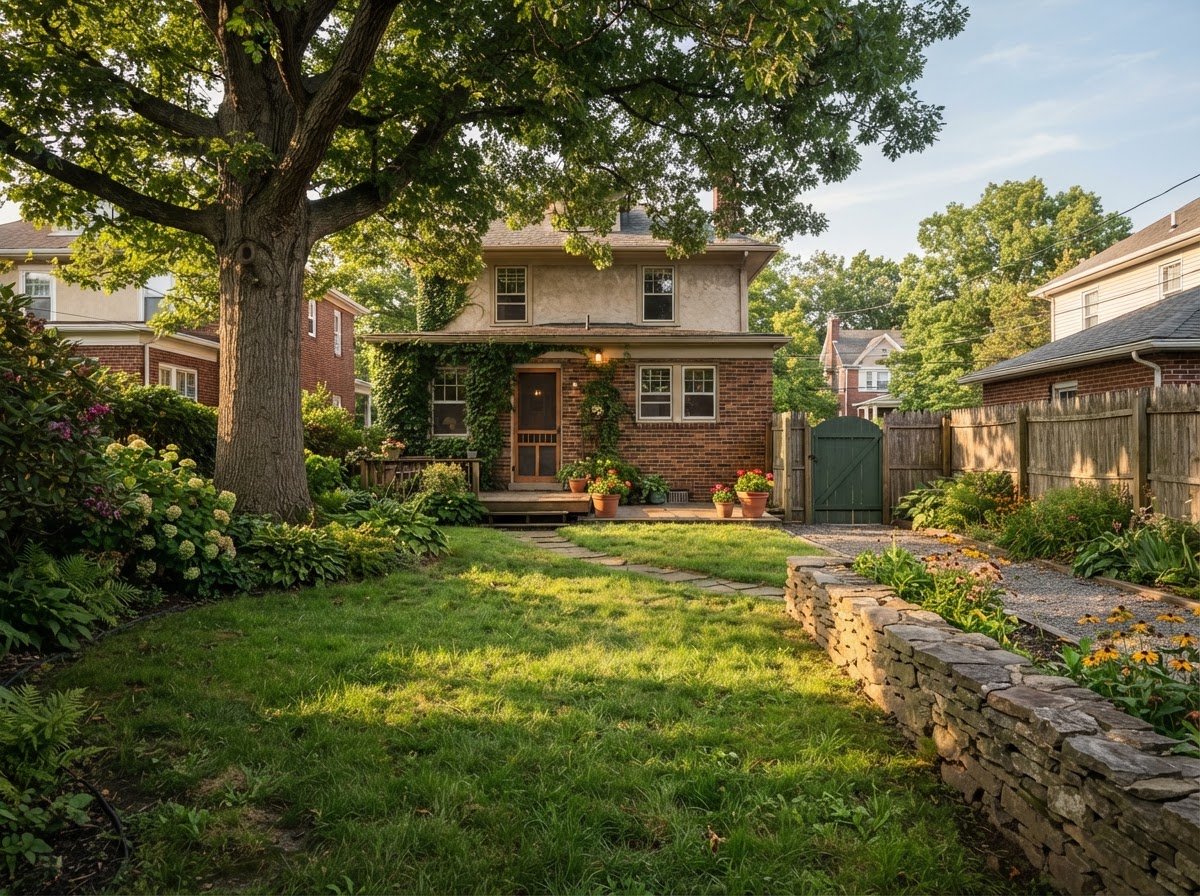
That combination has character. The house feels settled into the neighborhood. The landscaping has had time to develop. A thick, well-maintained lawn can bring the whole property together. I genuinely enjoy those lawns.
Then I walk into the backyard. Now I see the narrow gate, the exposed roots, the grass beside a retaining wall, and the patch of lawn sitting a few steps above everything else. Suddenly, that “easy little yard” needs more thought than it did from the street.
That is something you learn after spending years walking lawns and operating equipment: a small lawn is not automatically a simple lawn. But it can be an excellent opportunity. You do not need an estate-sized property to have a lawn you are proud of. You need a plan that makes sense for the grass, trees, soil, access, and the way you use the property.
That is the perspective I bring to lawn care in Allentown, PA.
From the street
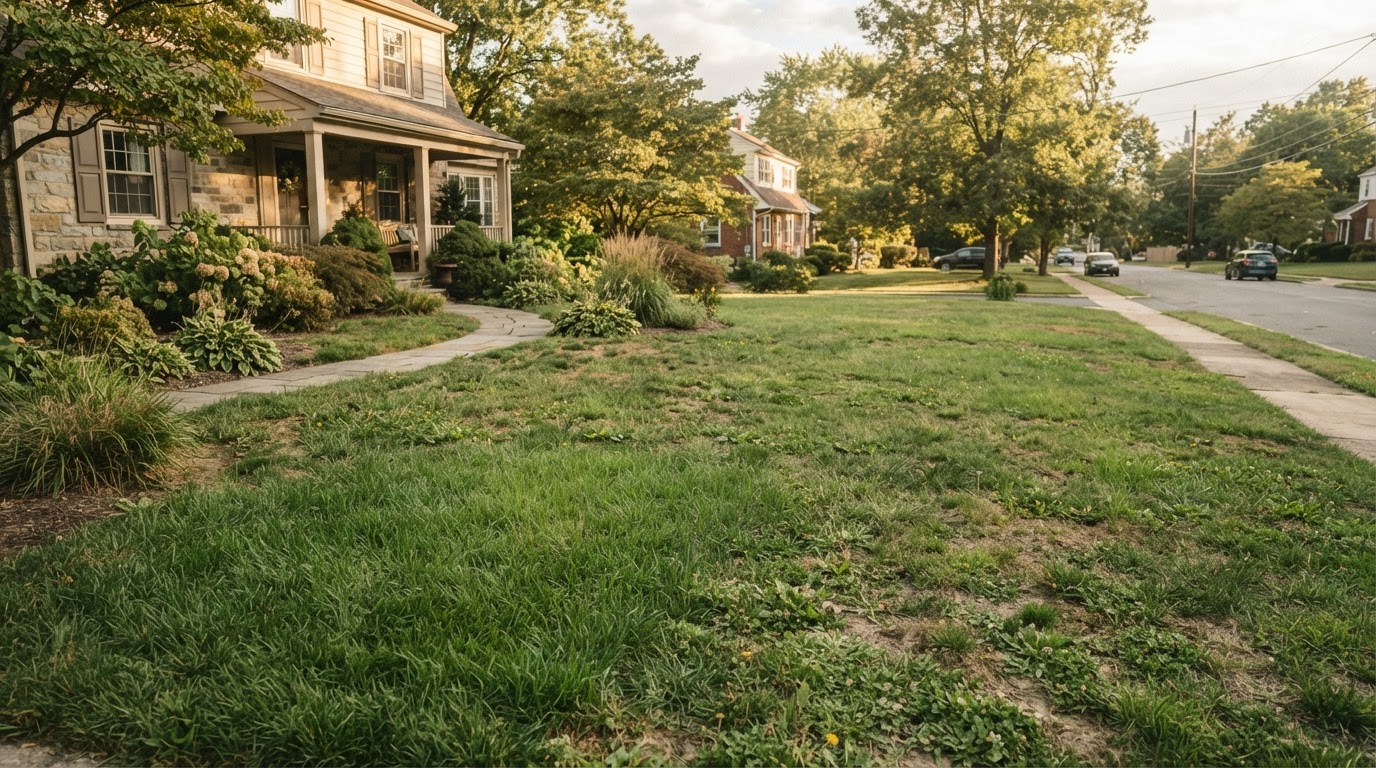
Front yardA manageable stretch of lawn, a beautiful mature tree, a settled neighborhood. It can look like an easy little yard.
Around back
BackyardA narrow gate, exposed roots, grass beside a retaining wall, a lawn sitting a few steps above everything else. Suddenly it needs more thought.
The Quick Answer
A small lawn is not automatically a simple lawn — but it can be an excellent opportunity.
An Allentown lawn with character — an older home, a mature tree, a narrow backyard — needs a plan that fits the grass, trees, soil, access, and the way you use the property. Measure it, understand the conditions, recommend the appropriate work, and explain the price.
What I Like About Allentown Lawns
When I think about Allentown, I do not picture one standard lawn. I think about established properties along Tilghman Street, homes in the West End, and residential streets around the Allentown Fairgrounds. I think about the settings near Cedar Beach Park and Trexler Memorial Park, where a house, its trees, and its lawn can have a very different relationship than a newer, wide-open property.
Farther along West Tilghman Street, Allentown Municipal Golf Course is another familiar reference point. The city lists the course at 3400 West Tilghman Street. I am talking about the surrounding residential area — not suggesting the course is a Golden Green customer. Then there are properties around North Cedar Crest Boulevard, Broadway, and the broader western Allentown area.
Some lawns are compact. Others have more room. Some are sunny in front and heavily shaded behind the house. A property can have a straightforward front yard and a backyard that requires an entirely different approach. That variety is what makes the work interesting.
The neighborhood gives me context. The actual lawn tells me what to recommend.
Allentown Lawn-Care Reference Points
Established residential properties along a familiar west-side corridor.
Older homes with mature landscaping and developed shade.
Residential streets near the Allentown Fairgrounds.
Settings where a house, its trees, and its lawn have a real relationship.
Surrounding residential area — not a claim the course is a customer.
Broader western Allentown residential settings.
Descriptive neighborhood references — not a claim that any property or course is a Golden Green customer.
An Allentown Address Does Not Always Mean the City of Allentown
This distinction matters when homeowners discuss local lawn care. Springhouse West Park and the Westwood Heights neighborhood are in South Whitehall Township. Springhouse West Park has an Allentown mailing address, but it is not a City of Allentown park. Lone Lane Park is in Upper Macungie Township, at Schantz Road and Lone Lane. The township identifies it as being between the Windermere and Kraft Village developments, with an Allentown mailing address.
So when I talk about lawns around Blue Barn Road, Schantz Road, Grange Road, Cetronia Road, and Lone Lane, I am thinking about the wider Allentown-area market — not treating every Allentown mailing address as the same municipality. Those roads and neighborhoods are useful landmarks. They are not a substitute for looking at the property. We still need to know where the lawn is, how much turf is being treated, how we can access it, and what conditions we are working with.
Mature Home, Mature Trees, Older Lawn: Beautiful Potential, Different Expectations
Some of my favorite properties have an older house, established trees, and a lawn that has been there for decades. But those lawns have a history. Perhaps different sections were seeded at different times. A previous homeowner patched one area with one type of seed and another area with something else. A tree grew larger. A backyard became more shaded. A section beside the driveway gradually thinned.
An older lawn is not automatically a poor lawn. Plenty of established turf is worth keeping. But when parts of the lawn repeatedly disappoint, I want to understand what is growing there and whether it fits the conditions. Fertilizer can support the existing plants. It does not convert one grass species or variety into another. Overseeding is one way to introduce desirable turfgrass into an existing stand, provided there is a suitable place for it to establish.
Fertilizer feeds the grass you have. Overseeding gives you an opportunity to change what the lawn is made of.
What an Older Lawn Has Been Through
Seeded at different times
Different sections may have different grass from different decades.
Patched with different seed
A previous homeowner used one type here, another there.
Trees grew larger
A sunny area became shaded over the years.
Sections thinned gradually
Beside the driveway, under the tree, along the path.
Why I sometimes talk about four or five falls
In my experience, some established lawns have changed dramatically over four or five consecutive fall seasons of appropriately timed aeration and overseeding, alongside good maintenance. Not because one service replaced the entire lawn. We created opportunities for new grass to establish, evaluated the results, and repeated the work where the lawn still needed it.
That is how I think about Sunny Seed Mix: as part of an ongoing effort to improve the turf — not a promise that one application of seed will erase decades of lawn history. Four or five years is a field observation, not a requirement for every property. A reasonably healthy lawn might show substantial improvement after one fall. A different lawn may need several seasons. And if a lawn keeps failing for the same reason, we should investigate that reason — not simply sell another overseeding. I explain that distinction more fully in How Many Years of Aeration and Overseeding Does It Take to Transform a Lawn?.
Why I Sometimes Talk About Four or Five Falls
A field observation, not a requirement for every property. We create opportunities, evaluate results, and repeat the work where the lawn still needs it.
Aerate and overseed. Introduce desirable grass where there is a suitable place to establish.
Evaluate results. Repeat the work where the lawn still needs it. Feed the established turf.
Thin areas continue to fill. We correct the reasons a section keeps struggling.
Good maintenance + repeated seeding adds up. A field observation, not a requirement for every property.
Improvement compounds year after year — but a reasonably healthy lawn might show substantial improvement after one fall, while another may need several seasons.
The 9,000–12,000-Square-Foot Lawn Can Be a Sweet Spot
There is another type of property I enjoy evaluating. Picture a house that is approximately 30 or 40 years old, with a lawn somewhere around 9,000–12,000 square feet. The trees have developed, but they have not necessarily shaded out the entire yard. There is room to operate equipment, and much of the existing turf may already be worth preserving. That can be a very workable combination. I am using those sizes and ages as an example — not claiming that they describe the average Allentown property.
On a lawn like that, the starting point may be relatively good. Perhaps we need to improve several thin areas, address weeds, and introduce additional grass rather than rebuild nearly everything. In my experience, those properties can sometimes show a quicker turnaround than lawns with severe shade, difficult access, or large amounts of unwanted grass. But I would never promise faster results simply because the house is newer.
The date the house was built does not tell me what seed was planted or how the lawn has been maintained. We still have to look.
The 9,000–12,000-Square-Foot Sweet Spot
Golden Green calculates pricing around 1,000 sq ft of treatable lawn. The house, driveway, and beds aren’t part of the turf-treatment area.
| Treatable lawn | Relative material | What to expect |
|---|---|---|
4,000 sq ft | 1× (smallest) | Compact lawn. Less material, but setup, access, and labor still contribute. |
8,000 sq ft | 2× | Mid-size. A workable balance of product and planning. |
12,000 sq ft | 3× | Subdivision lawn. More product, but still manageable when measured. |
Illustrative sizes. Total service price isn’t exactly proportional — travel, setup, access, and labor still contribute to the work.
The Tree Canopy Is Part of the Lawn-Care Conversation
This is where I want Golden Green to be particularly honest. A homeowner may love a mature tree and want thick grass growing directly beneath it. I understand the appeal. But a seed bag cannot manufacture sunlight. Penn State identifies competition for light, water, and nutrients as major reasons turf struggles beneath trees. Shade can also reduce turf density and vigor.
So before I recommend seeding that area, I want to ask some practical questions. Those are not excuses. They are the conditions we need to understand before making a promise.
What the Tree Competes For
Penn State identifies competition for light, water, and nutrients as major reasons turf struggles beneath trees. A seed bag cannot manufacture sunlight.
Full competition
Full competition
Full competition
I do not want to sell you grass where grass has little chance
There may be a suitable turfgrass for a partially shaded area. But even shade-tolerant grasses have limits. Where the canopy is too dense or root competition is severe, a properly designed mulched area or shade-appropriate planting may make more sense. University of Maryland Extension recommends considering alternatives where tree shade and root competition make turf difficult to sustain. That does not mean removing a valuable tree just to make the lawn easier. It means respecting the property.
I also do not want to damage exposed roots or bury them under extra soil to create a smoother surface for grass. University guidance cautions against regrading over tree roots and recommends alternatives where shallow roots interfere with mowing.
I would rather give you an honest limitation before the sale than explain a predictable disappointment afterward.
Before Seeding Beneath a Tree
- How much sunlight reaches the ground during the growing season?
- What kind of tree is it? How dense is the canopy?
- Are large roots exposed?
- Is the area dry from root competition, or does moisture linger?
- Is it also the path everyone uses to reach the backyard?
What About Patches of Zoysia in an Older Allentown Lawn?
I have also encountered older lawns with patches of zoysia mixed into the turf. That changes the conversation. Zoysia is a warm-season grass. Unlike the cool-season grasses commonly used in Pennsylvania lawns, it grows most actively in warm weather and loses its green color with cold-weather dormancy. A tan patch during colder months is not necessarily dead grass. Zoysia is not inherently a bad grass. The problem is whether it fits the lawn the homeowner wants.
Why a Zoysia Patch Changes the Conversation
Cool-season lawn
Most PA lawnsGrows actively in favorable spring and fall weather. Stays green through the cool season.
Zoysia (warm-season)
Tan in cold monthsGrows most actively in warm weather. Loses green color with cold-weather dormancy — not necessarily dead.
Overseeding is not the same as removing zoysia
I would not sell a homeowner years of ordinary overseeding on the promise that Sunny Seed Mix will eliminate established zoysia. That is a different kind of project. Penn State identifies unwanted zoysia as particularly difficult to control, and Purdue notes that complete renovation may be appropriate when changing a lawn containing difficult perennial grasses.
Some renovation approaches involve nonselective herbicides such as glyphosate. Golden Green does not use glyphosate or provide that type of lawn kill-off and complete replacement service. When a homeowner wants unwanted zoysia removed, I would recommend discussing the scope with a qualified landscape or turf-renovation contractor. The project may involve a localized section or a larger renovation; it should not automatically mean removing every part of the lawn. The contractor needs to explain the removal method, potential regrowth, soil preparation, and establishment plan. My responsibility is to recognize when the lawn needs a different service — not pretend our standard program does something it does not.
A Small Lawn Can Be a Big Equipment Puzzle
This is one of the details homeowners often do not see until service day. A property may have a small front lawn, a narrow strip beside the house, and a backyard on a separate level. Between those areas are steps, gates, walls, planting beds, and roots. That lawn might require less product than a large open yard, but it can require more planning per square foot.
I have worked on properties where a large stand-on machine simply was not the right choice for every section. Golden Green uses professional equipment, including Stinger hydraulic aeration equipment where suitable. But the goal is not to put the largest machine on every lawn. Sometimes a smaller walk-behind aerator is more appropriate. Sometimes access limits what can safely be done, and another preparation method needs to be considered. That is why we want gate measurements and information about slopes, steps, and separate lawn levels before scheduling.
The equipment should fit the property — not the other way around.
A Small Lawn Can Be a Big Equipment Puzzle
Steps, gates, walls, planting beds, and roots sit between the front lawn, the side strip, and the backyard. Sometimes a smaller walk-behind aerator is more appropriate than a large stand-on machine. We want gate measurements, slopes, and separate lawn levels before scheduling.
Our article about Stinger aeration equipment and overseeding explains why equipment matters. But equipment selection will always come back to the actual yard.
Allentown Weather Changes What the Lawn Needs
A lawn that looks encouraging in May may struggle in July. That does not automatically mean it needs a stronger fertilizer application. Cool-season grasses generally make their strongest growth during favorable spring and fall conditions and may slow down or become semi-dormant during hot, dry weather. My job is to account for that — not ignore it. A sunny lawn beside pavement may need a different conversation from a shaded backyard. A recently seeded section has different needs from established turf.
When summer exposes a weakness, I want to determine whether we are looking at temporary stress, actual turf loss, insects, disease, watering problems, or unsuitable growing conditions.
A brown area is a reason to investigate. It is not a diagnosis by itself.
Allentown Weather Changes What the Lawn Needs
The National Weather Service lists a normal July high of approximately 86°F at Allentown/Lehigh Valley International Airport — a climate figure, not the exact temperature in your backyard. A brown area is a reason to investigate, not a diagnosis by itself.
What Kind of Soil Does an Allentown Lawn Have?
I would rather examine your property than assign every Allentown lawn the same soil description. The front yard and backyard may have different histories. One area may have been disturbed during construction. Another may collect water. A well-used passage may be compacted while an adjoining section is not. Penn State’s lawn-renovation guidance emphasizes evaluating the existing conditions and correcting underlying problems as part of an improvement plan. That is why soil testing can be useful when the lawn’s response raises questions. It helps us move beyond assumptions about soil acidity and nutrient needs.
Lime should have a reason behind it
Fall lime can be appropriate when a soil test indicates it is needed. But the presence of trees, the age of the house, or the fact that the lawn is in Pennsylvania does not automatically establish a lime requirement. Penn State recommends applying limestone according to soil-test results rather than guessing. I want a lime recommendation connected to the lawn.
“It is fall” tells us the season. It does not tell us the soil pH.
Small Lawns Can Make Comprehensive Care More Approachable
This is one reason I encourage homeowners not to assume that a fuller lawn-care plan is out of reach. Golden Green calculates much of its service pricing around 1,000 square feet of treatable lawn. We are not fertilizing your entire lot. The house, driveway, patio, and landscape beds are not part of the turf-treatment area. At the same application rate, a 4,000-square-foot lawn needs one-third as much product as a 12,000-square-foot lawn. That does not mean the total service price will be exactly one-third. Travel, setup, access, equipment, and labor still contribute to the work. But the smaller treatment area can make it practical to consider services that a homeowner assumed would be too expensive.
A larger subdivision lawn may still be manageable, too. The right answer comes from measuring it and explaining the options — not deciding from the street that it must cost a fortune.
You do not need to guess whether a comprehensive program fits your budget. Get the lawn measured and look at the actual quote.
What a Golden Green Lawn Plan Can Include
When homeowners ask about lawn care services in the Lehigh Valley, I want them to understand both the services and the reasoning behind them. A complete plan does not mean every property needs everything.
What a Golden Green Lawn Plan Can Include
Seasonal fertilization & weed control
The six-step program structures seasonal care; weed control is coordinated with the lawn's condition and other planned work.
Preventative grub control
Discussed where appropriate — protecting the lawn before damage starts.
Mechanical core aeration & overseeding
Often the most valuable conversation for an older, thin Allentown lawn — but not permission to ignore shade, roots, or drainage.
Sunny's Seed Promise
Additional establishment support for qualifying program participants, under the offer's terms.
Lime — when justified
Based on a soil-test recommendation, not the season, the city, or the presence of trees.
Preventative grub control and the qualifying flea-and-tick offer
We also discuss preventative grub control where appropriate. Golden Green’s published offer provides two complimentary flea and tick applications for qualifying customers who combine the six-step fertilization and weed-control program with preventative grub control. The current offer page explains the bundle. I want homeowners to understand what is included, what is optional, and why a service is being recommended. The offer should make the decision clearer — not turn every lawn into the same package.
Soil-conditioning options and lime when justified
Some homeowners also ask about spring liquid aeration or soil-conditioning services. Those should be discussed separately from mechanical core aeration. Liquid products do not physically remove cores, and University of Minnesota turfgrass guidance reports little to no published support for liquid aeration as a replacement for mechanical aeration to relieve compaction. For me, every recommendation should answer a question: what problem are we trying to solve, and why is this the appropriate tool?
The Work Between Visits Still Matters
A lawn-care program is not only what happens when the truck arrives. Mowing, watering, leaf management, traffic, and seed-establishment care all affect what happens afterward. Penn State emphasizes appropriate mowing and sharp equipment, while its shade guidance also notes the importance of removing accumulated leaves so they do not smother the grass. That matters on a property with mature trees. We can put effort into fall overseeding, but the young grass still needs suitable conditions afterward.
Doing the work and explaining the work belong together.
From Allentown to the Wider Lehigh Valley
My experience with lawns stretches across more than one neighborhood or property type. When I talk about the wider Lehigh Valley, I am thinking about Allentown, Bethlehem, and Easton, as well as communities toward Fogelsville, Orefield, Trexlertown, Breinigsville, Macungie, and Emmaus. There are also different settings around Catasauqua, Nazareth, Bath, Fountain Hill, Hellertown, and Center Valley. But a list of places is not the point. A row-home lawn, a subdivision backyard, and an estate property can all require different decisions. Even neighboring lawns can have different sunlight, drainage, turf, access, and uses.
Golden Green’s service-area information and quote process are the place to confirm address-specific availability.
Recognizing the town is useful. Understanding the lawn is the work.
From Allentown to the Wider Lehigh Valley
A row-home lawn, a subdivision backyard, and an estate property can all require different decisions. Recognizing the town is useful; understanding the lawn is the work.
The Promise Should Fit the Property
This is something I feel strongly about. A lawn-care company can advertise beautiful grass. It can offer fertilizer, weed control, aeration, and seed. But after selling the service, it has to explain what is realistic on that particular property. I do not want Golden Green to make a promise that sounds wonderful at the kitchen table and falls apart under the tree in the backyard.
The Promise Should Fit the Property
- If an exposed root system limits our equipment, we should say so.
- If a canopy limits the grass, we should say so.
- If an unwanted zoysia patch needs a renovation service we don't provide, we should say so.
- If the lawn needs several seasons of improvement, we should explain that before expecting a one-visit transformation.
You Do Not Need a Bigger Lawn. You Need the Right Plan for Yours.
I still like that picture: an established home, a beautiful tree, and a lawn that brings the property together. But after years in this business, I know the best result does not always mean forcing grass into every corner. Sometimes it means improving the sunny lawn and respecting the shaded planting area. Sometimes it means patiently introducing desirable turf over several falls. Sometimes it means a relatively quick improvement because the lawn already has a good foundation. And sometimes it means being honest that a section needs more extensive renovation.
That is what makes Allentown lawn care interesting to me. The properties have character. The lawns have history. And the homeowner deserves more than a treatment recommendation based only on the ZIP code.
Measure the lawn. Understand the conditions. Recommend the appropriate work. Explain the price. Follow through.
Golden Green — Your Lawn’s Best Friend.
You Don’t Need a Bigger Lawn. You Need the Right Plan for Yours.
Measure the lawn. Understand the conditions. Recommend the appropriate work. Explain the price. Follow through. Golden Green is accepting inquiries for spring 2027 lawn-care scheduling.
Keep Reading About Allentown & Lehigh Valley Lawn Care
These related pages go deeper on the services and reasoning behind Allentown lawn care:
Lawn Care in Allentown, PA
Our Allentown service-area page — availability, services, and a clear path to a property-specific quote.
Lawn Fertilization in Allentown, PA
The complete Allentown fertilization guide — schedule, soil health, and a greener lawn through the year.
How Many Years to Transform a Lawn?
Why some lawns change dramatically over four or five fall seasons of aeration and overseeding.
Sunny’s Seed Mix
Part of an ongoing effort to improve the turf — not a promise that one application erases decades of lawn history.
Helpful lawn care advice for Pennsylvania homeowners
If this guide helped you, add Golden Green as a Preferred Source on Google to see more of our lawn care guides in Google Search and AI experiences.
Frequently Asked Questions About Allentown Lawn Care
Can a small Allentown lawn receive a comprehensive lawn-care program?+
Yes. The appropriate plan depends on the treatment area, condition, access, and homeowner's goals. A smaller lawn may require less material, but the quote must still account for the work involved.
Do older lawns always need four or five years of overseeding?+
No. Four or five consecutive falls reflects what I have seen help some lawns undergoing substantial improvement. It is not a universal requirement or a guarantee. We should evaluate progress and correct the reasons a lawn keeps struggling.
Can Sunny Seed Mix grow beneath any mature tree?+
No seed mix can overcome every shade and root-competition problem. Partially shaded areas may support suitable turf, while severely limited sites may be better suited to mulch or other plantings.
Can you use a Stinger aerator on every Allentown property?+
No. Equipment selection depends on safe access, gate width, slopes, obstacles, roots, and the size and layout of each lawn section. We want that information before the job is scheduled.
Will aeration and overseeding eliminate zoysia patches?+
Ordinary overseeding should not be sold as a dependable zoysia-removal method. Unwanted zoysia can require a separate renovation plan. Golden Green does not provide glyphosate-based lawn kill-offs or complete lawn replacement.
Does every lawn need fall lime?+
No. Lime should be based on a soil-test recommendation, not automatically included because of the season, city, or presence of mature trees.
How do I find out what Golden Green would recommend for my lawn?+
Start with the Golden Green pricing and quote page. Share your address, concerns, and any access limitations so the recommendation can account for the actual property.