Should You Bag Your Grass Clippings or Leave Them on the Lawn?
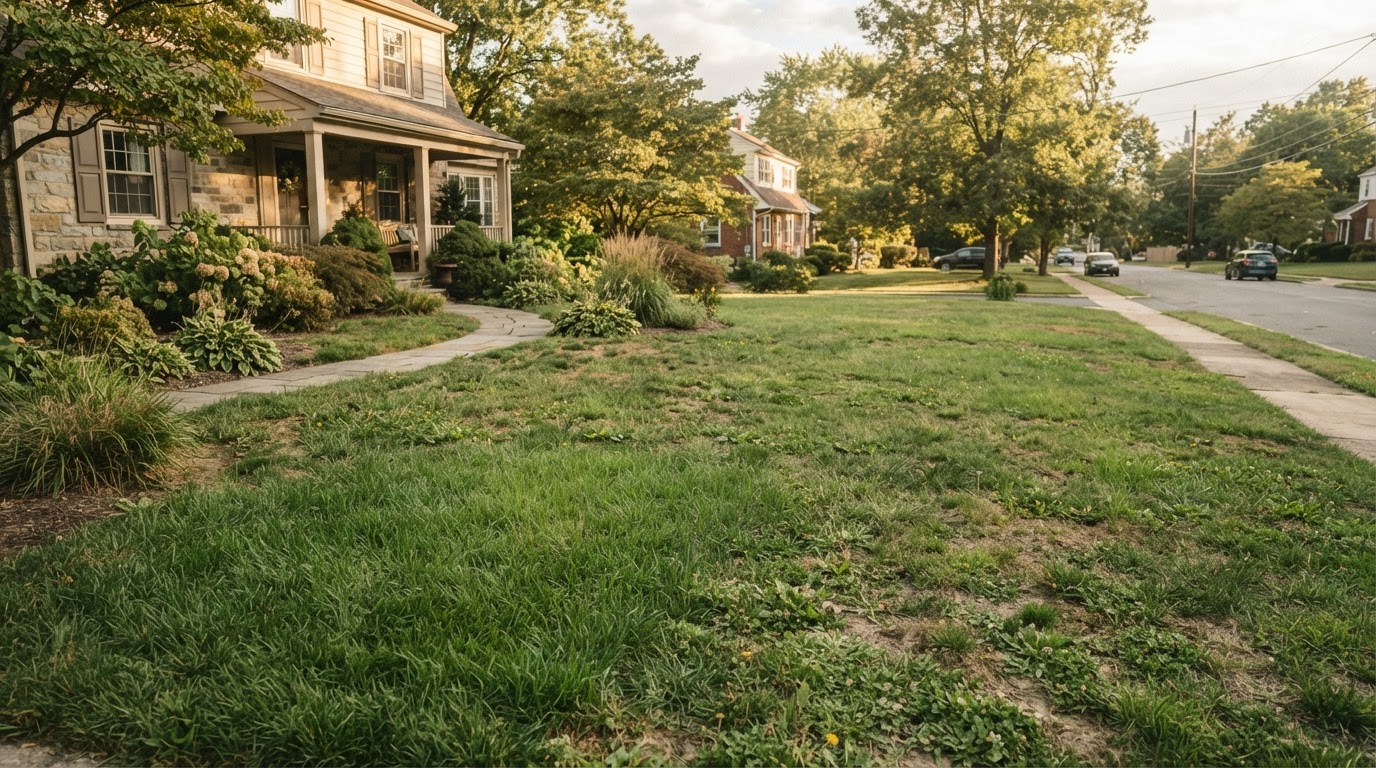
Most of the time, leave them. When a lawn is mowed regularly and the clippings are small and evenly distributed, they can settle into the turf, decompose, and return nutrients. Bagging or removing clippings makes sense when the alternative is leaving heavy piles that cover the grass.
But I want to explain the difference, because “leave your clippings” can become bad advice when the rest of the mowing job is wrong. Picture a spring Saturday in Pennsylvania. You finally have time to mow. It rained earlier in the week, the lawn has grown considerably, and you would like to finish before the rest of the day disappears.
You make the first pass. Behind the mower is a row of wet grass clippings. You make another pass. More clippings. Now the lawn looks less like a finished job and more like something you will have to clean up. Naturally, you think: “This is why I always bag.”
I understand that reaction. But before deciding clippings are the problem, I would ask a different question: Did we leave too much grass to cut at once? At Golden Green, that is how I want to approach lawn care. Look at what caused the problem before adding another chore, product, or service. Sometimes a better lawn comes from doing something differently — not simply doing more.
The Quick Answer
Most of the time, leave them — but “leave your clippings” becomes bad advice when the rest of the mowing job is wrong.
When a lawn is mowed regularly and the clippings are small and evenly distributed, they settle into the turf, decompose, and return nutrients. Bagging or removing clippings makes sense when the alternative is leaving heavy piles that cover the grass. The difference starts with how you mow.
Recycling Clippings vs. Leaving a Mess
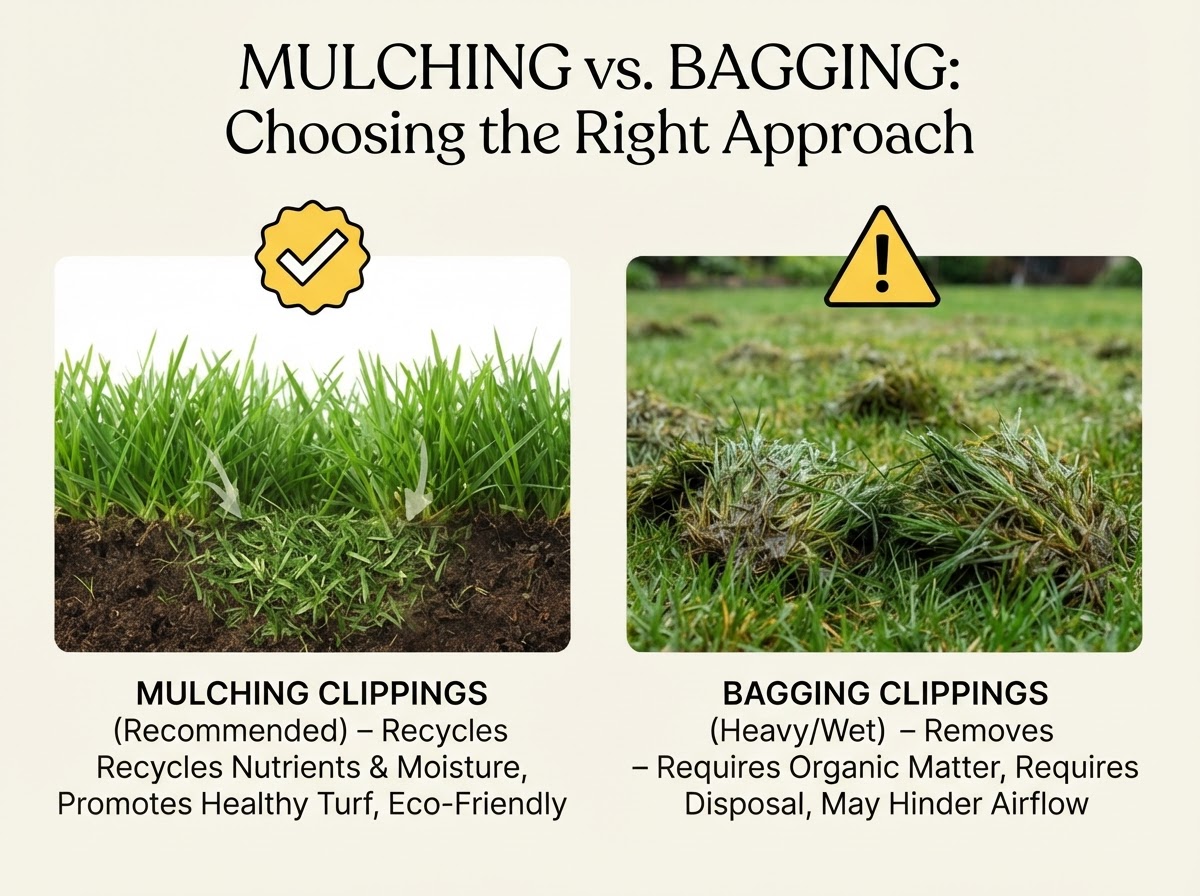
Returning clippings to the lawn is often called grasscycling. It means allowing suitably small pieces to remain where they can break down — not leaving thick, wet piles across the surface.
Leave Fine Clippings
Fine clippings scattered through the grass settle into the turf, decompose, and return nutrients to the lawn.
Disperse Small Clumps
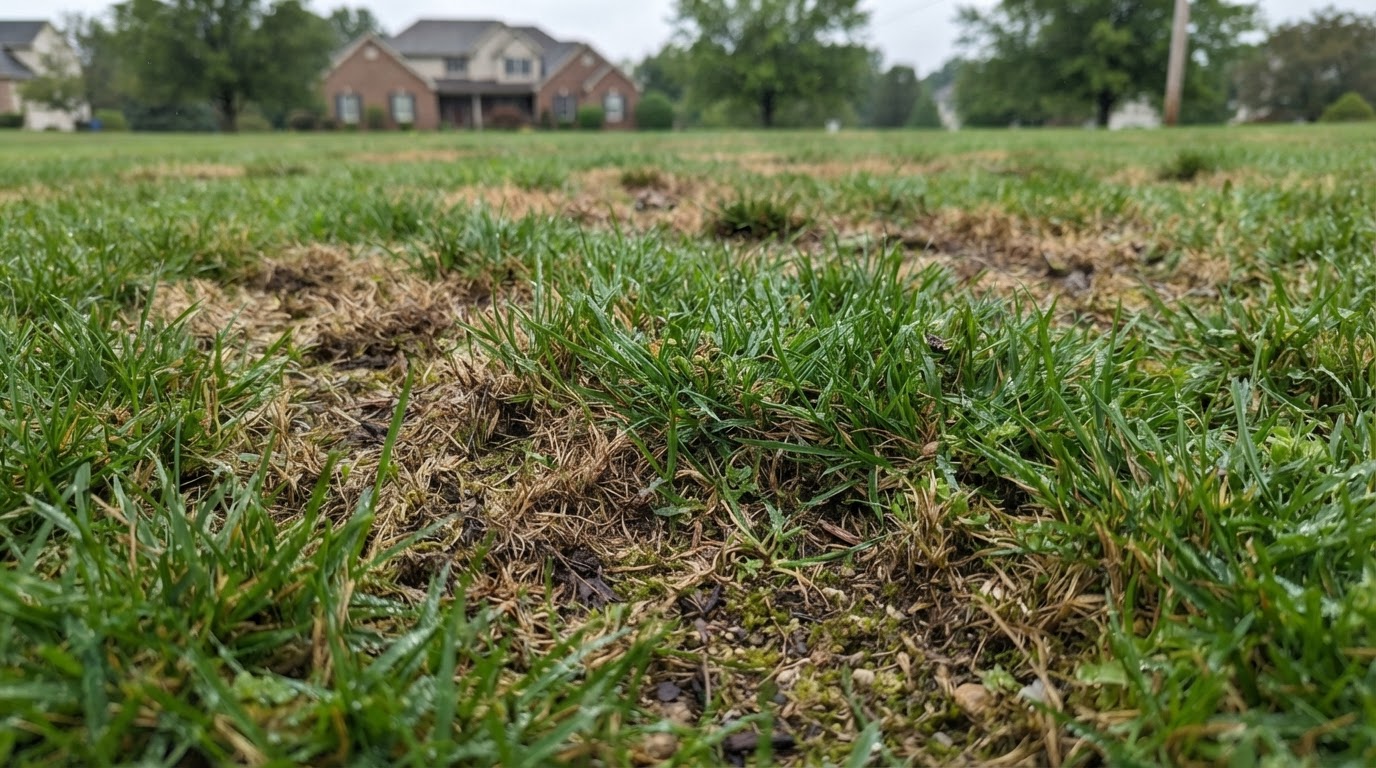
A few concentrated rows or clumps should be dispersed or removed rather than left to shade the grass below.
Remove Heavy Accumulations
Heavy, wet piles across much of the lawn mean the excess should be addressed — then adjust mowing timing or frequency.
Purdue recommends breaking up accumulated clippings so they do not shade the grass below. Mowing more frequently during spring growth helps prevent the problem.
I want you returning useful clippings — not burying your lawn under yesterday’s growth.
Are You Bagging Up Nutrients Your Lawn Could Reuse?
This is the part that often changes how homeowners think about clippings. The leaf tissue you cut contains nutrients. When you remove it, those nutrients leave the lawn with it. Penn State reports that, over a three-year study, Kentucky bluegrass leaf clippings contained nitrogen equivalent to 46–59% of the nitrogen applied as fertilizer. That helps explain why returning clippings can reduce supplemental fertilizer requirements.
Are You Bagging Up Nutrients Your Lawn Could Reuse?
The leaf tissue you cut contains nutrients. When you remove it, those nutrients leave the lawn with it.
Over a three-year study, Penn State found Kentucky bluegrass leaf clippings contained nitrogen equivalent to 46–59% of the nitrogen applied as fertilizer.
That does not mean every homeowner can cut the fertilizer bill in half. It is not a guaranteed percentage reduction for every lawn, and the nutrients do not all become available immediately. But it challenges the idea that every clipping is useless waste.
For me, the practical question is: Why automatically haul away something the lawn can reuse? That does not mean bagging is always wrong. It means bagging should have a reason.
Mowing and Fertilization Belong in the Same Conversation
When a homeowner asks about fertilizer, I want to know how the lawn is maintained. Are clippings consistently returned? Are they always collected? Is the grass growing comfortably, or is the homeowner struggling to keep up? Research summarized by the University of Minnesota supports accounting for clipping return when planning turf nutrition. That is relevant to Golden Green’s fertilization and weed-control program.
A six-step service schedule is not an instruction to apply six identical, heavy doses of nitrogen.
The amount, source, and timing of nutrition should fit the lawn. Penn State’s professional fertility guidance emphasizes adjusting application rates and scheduling, and warns that excessive early-spring nitrogen can drive unwanted leaf growth. I do not measure a successful fertilizer application by how quickly we fill the homeowner’s mower bag. I want appropriate growth and a lawn the homeowner can reasonably maintain.
Pennsylvania Fertilizer Rates Still Matter
Pennsylvania's published limits generally include 0.7 pound of readily available nitrogen and 0.9 pound of total nitrogen per 1,000 square feet per application — subject to the applicable enhanced-efficiency provisions and other requirements. Follow the current law and product label. For a professionally managed lawn, let your provider know whether you normally bag or recycle — that is useful information, not a reason to independently add another fertilizer treatment.
Do Grass Clippings Cause Thatch?
Ordinary clipping return is not a significant cause of thatch. Thatch is a layer of accumulated, slower-decomposing plant material between the soil and actively growing turf. It includes material such as stems and roots. The leaves removed during routine mowing contain relatively little of the tougher material that resists decomposition.
Do Grass Clippings Cause Thatch?
Ordinary clipping return is not a significant cause of thatch.
Thatch is
A layer of accumulated, slower-decomposing plant material between the soil and actively growing turf — including stems and roots.
Clippings are
Mown leaf tissue that contains relatively little of the tougher material that resists decomposition. They break down much more readily.
The takeaway
A row of fresh clippings lying across the lawn is not automatically a thatch layer. It may simply be mowing debris that needs to be dispersed or removed.
University of Minnesota turfgrass specialists explain that clippings break down much more readily than the tougher material that resists decomposition.
Fresh clippings and an established thatch problem are not the same thing.
And if the lawn really does have excessive thatch, I want it evaluated as thatch — not diagnosed from the fact that the homeowner stopped using a mower bag.
The Spring Growth Trap: Saturday May Not Be Soon Enough
A weekly mowing appointment is convenient. The grass does not know about the appointment. Penn State recommends basing mowing frequency on actual growth. During the spring growth peak, some lawns need mowing more than once a week; during dry periods, they may need less.
Suppose the lawn was cut last Saturday. By Thursday, it is ready again. Waiting until Sunday may fit the schedule, but it can make the eventual job more difficult. I would rather adjust the schedule than repeatedly ask the mower to process too much grass. For homeowners who hire someone to cut the lawn, this is a worthwhile question before spring: “What happens when my lawn needs mowing more often than once a week?”
The Spring Growth Trap: Saturday May Not Be Soon Enough
A weekly mowing appointment is convenient. The grass does not know about the appointment. Penn State recommends basing mowing frequency on actual growth.
The lawn was cut on schedule.
By Thursday the grass is ready. Waiting until Sunday can make the eventual job more difficult.
The calendar fit the schedule — but the grass didn't. The result is a heavy crop of long clippings.
Use the One-Third Rule
A useful rule of thumb is to remove no more than one-third of the grass’s height in one mowing. The rule is not an instruction to wait until the last possible moment. It is a reminder not to let the lawn become excessively tall and then remove most of its leaves in one pass. Smaller amounts of removed tissue are easier to distribute than a heavy crop of long clippings.
Use the One-Third Rule
Remove no more than one-third of the grass’s height in one mowing. It is a reminder not to let the lawn become excessively tall and then remove most of its leaves in one pass.
Before mowing
After mowing
An example, not the required height for every lawn. If you maintain a lawn at three inches, mow before it grows beyond approximately 4½ inches. Cutting from 4½ to three removes one-third of its height.
Regular, manageable cuts beat occasional severe cuts.
What Mowing Height Makes Sense in Pennsylvania?
Penn State lists suggested ranges for common cool-season lawn grasses. These are general recommendations, not a requirement to choose the lowest setting. Grass species, site conditions, and seasonal stress should influence the choice. For many of the residential cool-season lawns I discuss with homeowners, I prefer working toward the higher end of a suitable range. Proper mowing height also influences turf density and the opportunity for weeds to establish. This is one reason I do not view mowing and weed control as unrelated subjects.
What Mowing Height Makes Sense in Pennsylvania?
Penn State lists these suggested ranges for common cool-season lawn grasses. General recommendations — not a requirement to choose the lowest setting.
| Grass | Suggested mowing height |
|---|---|
| Kentucky bluegrass | 2½–3½ inches |
| Perennial ryegrass | 2½–3½ inches |
| Fine fescues | 2½–3½ inches |
| Tall fescue | 3–3½ inches |
For many residential cool-season lawns, I prefer working toward the higher end of a suitable range. I would not lower the mower simply to make the next cut seem farther away.
Do You Need a Mulching Mower?
Not necessarily — but a suitable mulching setup can help. Mulching mowers are designed to process and redistribute clippings into the turf. Finely cut material is generally easier to return without leaving obvious residue. Oregon State recommends mulching equipment while also emphasizing regular mowing and avoiding excessive clipping buildup. A conventional mower may also return clippings successfully when it distributes them evenly and is operated correctly. You do not have to buy a new mower merely to stop bagging every cut.
However, use the configuration approved by the manufacturer. Some mowers require a specific plug, deflector, or conversion kit. Do not remove a collection attachment or safety guard and assume the mower is safe to operate that way. The mower setup should help you perform the job — not create another problem.
Sharp Blades Still Matter
A mulching setup does not cancel out a dull blade. A sharp mower blade cuts the grass more cleanly. A dull one can tear the leaf and leave ragged edges. University of Minnesota includes blade condition among its fundamental recommendations for lawn mowing. Before assuming the lawn needs another treatment, I would inspect the cut itself. Are the leaf tips reasonably clean, or do they look shredded? That is the subject of our guide to dull mower blades and grass that looks brown after mowing.
What Should You Do When Rain Delays Mowing?
This happens. A mowing plan has to allow for weather. If the grass becomes overgrown, I would not insist on leaving every clipping simply to defend a “never bag” rule. Oregon State recommends collecting excessive clippings after missed mowings or during conditions that produce heavy residue, then returning to recycling once the growth is manageable again. Where a light additional pass will disperse clippings without cutting the grass lower or damaging the surface, that can be useful. Otherwise, remove the excess.
Bagging one difficult mowing does not mean you failed at grasscycling. It means you responded to the lawn in front of you.
When Bagging or Removal Makes Sense
My recommendation is not “never bag.” It is “do not bag automatically.” There are legitimate exceptions. A careful lawn-care plan has room for them.
When Bagging or Removal Makes Sense
My recommendation is not “never bag.” It is “do not bag automatically.”
Heavy clippings are covering the grass
Remove or disperse them. The goal is to expose the living turf — not leave it under a blanket.
Leaves and debris are mixed in
Light, properly mulched tree leaves can be returned. A heavy accumulation that obscures the lawn needs a different approach.
A diagnosed disease warrants it
In some disease situations, collecting clippings can be part of the recommendation — but a brown patch alone is not enough reason to assume disease.
Equipment requires a different setup
Follow the mower's instructions and use its required safety components. Recycling is not a reason to bypass them.
What If the Lawn Has Weeds?
I would not make routine bagging the main weed-control strategy. University of Minnesota explains that collecting weed seedheads does not remove the existing soil seed bank and generally should not be expected to resolve a lawn’s weed problem. That does not mean ignore an unusual weed or move infested debris indiscriminately. It means we should identify the weed and recommend a suitable approach rather than assume the mower bag will solve everything.
Mowing practices, turf density, and appropriately selected weed treatments have different jobs.
Be Careful With Clippings From a Treated Lawn
This is particularly important for customers receiving fertilization and weed control. Leaving clippings on the lawn is one question. Moving those clippings into a vegetable garden, flower bed, or compost pile is another. Some herbicide labels restrict using treated clippings as mulch or compost. I want Golden Green customers to ask about this. A quick question is better than accidentally moving a lawn treatment into a place where it does not belong.
Be Careful With Clippings From a Treated Lawn
Moving treated clippings into a garden, flower bed, or compost pile is a different question than leaving them on the lawn.
Some herbicide labels restrict using treated clippings as mulch or compost. Certain residues can remain active even through composting and injure sensitive plants. Before moving clippings elsewhere, check the actual product label and your provider's instructions — and do not assume every product is safe after the same number of days or mowings.
Keep Clippings on the Lawn — Not in the Street
Grasscycling means returning clippings to the turf. It does not mean blowing them into the road, gutter, or storm drain. Pennsylvania’s fertilizer guidance advises keeping nutrients on the intended site and removing lawn clippings from sidewalks and driveways so they do not move off the property.
Keep Clippings on the Lawn — Not in the Street
Grasscycling means returning clippings to the turf. It does not mean blowing them into the road, gutter, or storm drain. Pennsylvania’s fertilizer guidance advises keeping nutrients on the intended site and removing lawn clippings from sidewalks and driveways so they do not move off the property. The lawn should receive the benefit. The street should not receive the cleanup.
Soil Conditions and Watering Still Matter
Returning clippings does not correct every underlying lawn problem. If soil acidity needs attention, use a soil test rather than guessing. Penn State notes that most turfgrasses favor a soil pH around six to seven and recommends basing lime applications on test results. That is why soil testing and lime should be connected to an actual need — not sold as automatic fixes for visible mowing residue. Likewise, I would not turn on the irrigation simply to make clippings disappear. Water the lawn according to its needs, rainfall, and conditions — not as a substitute for managing excessive clumps.
Where Sunny Seed Mix Fits — and Where It Does Not
You do not need to buy grass seed to begin recycling your clippings. A healthy existing lawn can benefit from good mowing practices without being overseeded just because it is spring. But if the lawn remains thin or inconsistent, there may be a separate conversation about improving the turf. For qualifying seeding customers, review Sunny’s Seed Promise separately. No promise replaces the need for appropriate conditions and maintenance.
Where Sunny Seed Mix Fits — and Where It Does Not
You do not need to buy grass seed to begin recycling your clippings. A healthy existing lawn can benefit from good mowing practices without being overseeded just because it is spring. But if the lawn remains thin or inconsistent, there may be a separate conversation about improving the turf — aeration, overseeding, and site-appropriate seed such as Sunny Seed Mix. Clipping return helps conserve part of the lawn’s nutrition. Seeding introduces new plants. They are connected, but they are not the same service.
What Changes When You Stop Bagging by Default?
Some benefits are immediate: fewer stops to empty a catcher and less material to collect or dispose of. The nutritional effect develops as the clippings decompose. University research supports practical and nutrient-recycling benefits, but that is not a guarantee of a darker lawn after a fixed number of weeks. I would not promise that switching to mulching creates a perfect lawn in one season — or that it always reduces the cost of a service package. What I would expect is a more deliberate routine.
What Changes When You Stop Bagging by Default?
- Some benefits are immediate: fewer stops to empty a catcher and less material to collect or dispose of.
- The nutritional effect develops as the clippings decompose — not a guarantee of a darker lawn after a fixed number of weeks.
- What I expect is a more deliberate routine: watching growth rather than blindly following the calendar, keeping the blade ready, and telling your lawn-care provider how the grass is being maintained.
My Recommendation for Pennsylvania Homeowners
Whether you are caring for a compact Allentown yard, a lawn in Emmaus or Macungie, or another property across our five-county service area, my starting question is the same: What is left behind when you mow? If it is a modest amount of fine clippings, returning them is usually the sensible choice. If it is heavy residue covering the turf, address it and change the conditions that produced it. Do not turn a generally useful practice into an absolute rule. And do not assume extra cleanup automatically means better lawn care.
Mowing, Treatments & Soil Belong in One Conversation
Fertilization & weed control
A six-step schedule is not an instruction to apply six identical heavy doses of nitrogen. Nutrition should fit the lawn — and whether you bag or recycle informs the plan.
Soil testing & lime
If soil acidity needs attention, use a soil test rather than guessing. Lime should be connected to an actual need — not sold as an automatic fix for mowing residue.
Aeration & overseeding
You do not need to buy grass seed to begin recycling clippings. But if the lawn stays thin, aeration and overseeding — and site-appropriate seed — are a separate conversation.
A Better Lawn Is Not Always About Doing More
You already spend time maintaining your property. My goal is not to add work simply because that is how somebody has always done it. Before you fill another row of lawn bags this spring, take a look at what you are collecting. Is it excess material that needs to come off? Or is it a manageable amount of clippings that could have stayed where the grass grew? That is the decision.
Mow thoughtfully. Keep the cut manageable. Return useful clippings. Remove the excess when necessary.
And remember that a lawn-care program includes what happens between treatment visits. The fertilizer matters. So does the mower.
Golden Green — Your Lawn’s Best Friend.
Build a Better Lawn Plan
Does your lawn produce excessive growth, stay uneven, or seem difficult to maintain despite regular care? Let’s look at the whole picture: the turf, treatments, mowing, watering, and what the lawn actually needs.
Keep Reading About Mowing & Lawn Care
These related pages go deeper on the services and reasoning behind clipping management:
Fertilization & Weed Control
A six-step program structured around seasonal care — adjusted to the lawn, not applied as six identical heavy doses.
Weed Control
Mowing practices, turf density, and appropriately selected weed treatments have different jobs. Bagging is not a weed-control strategy.
Dull Mower Blades & Grass That Looks Brown After Mowing
A mulching setup does not cancel out a dull blade. Sharp blades cut the grass cleanly — inspect the cut itself before assuming another treatment is needed.
Soil Testing
Returning clippings does not correct every underlying problem. If soil acidity needs attention, use a soil test rather than guessing.
Aeration
If the lawn stays thin, aeration creates openings in the soil for new grass to establish — a separate conversation from recycling clippings.
Sunny’s Seed Mix
You don’t need seed to begin grasscycling — but when the lawn is thin, site-appropriate seed is part of improving the turf.
Citations Behind This Article
Penn State — clipping nitrogen & mowing
Reports Kentucky bluegrass leaf clippings contained nitrogen equivalent to 46–59% of fertilizer-applied nitrogen over a three-year study; recommends basing mowing frequency on actual growth; lists suggested cool-season mowing heights; identifies mowing as part of weed management.
University of Minnesota Extension — grasscycling & thatch
Supports clipping recycling; identifies excessive clumping as a reason to consider removal; explains clippings decompose readily and do not significantly contribute to thatch; supports accounting for clipping return in turf nutrition planning.
Purdue — breaking up accumulations
Recommends breaking up accumulated clippings so they do not shade the grass; identifies raking and another mowing pass as ways to disperse accumulations; recommends adjusting irrigation to actual need.
Oregon State University — mulching & treated clippings
Recommends mulching equipment while emphasizing regular mowing and avoiding excessive buildup; recommends collecting excessive clippings after missed mowings; explains certain herbicide residues can remain active through composting.
Pennsylvania fertilizer guidance
Published limits generally include 0.7 lb readily available nitrogen and 0.9 lb total nitrogen per 1,000 sq ft per application; advises keeping nutrients on the intended site and removing clippings from sidewalks and driveways.
University and Pennsylvania references are kept distinct from Golden Green’s field experience. No guaranteed dates, fixed water savings, or automatic multi-year transformation claims are made in this article.
Helpful lawn care advice for Pennsylvania homeowners
If this guide helped you, add Golden Green as a Preferred Source on Google to see more of our lawn care guides in Google Search and AI experiences.
Frequently Asked Questions About Grass Clippings
Should I bag grass clippings or leave them?+
Usually leave small, evenly spread clippings. Remove heavy accumulations rather than let them cover the turf. Routine bagging is not necessary when mowing is managed properly.
Do grass clippings cause thatch?+
Routine clipping return does not significantly contribute to thatch. Mown leaf tissue decomposes more readily than the tougher plant parts that accumulate in a thatch layer.
Can returning clippings reduce fertilizer needs?+
Yes, it can reduce the need for supplemental nutrients. The amount varies, so it should inform the fertility plan rather than trigger an automatic percentage reduction.
Is weekly mowing enough in spring?+
Not always. Base the interval on growth. Some lawns need more frequent mowing during the spring flush and less frequent mowing during slow-growth periods.
Should I always bag the first spring mowing?+
No. Evaluate what is present. Excess leaves and debris may need collection, but the fact that it is the first mowing does not automatically require bagging or cutting the lawn unusually low.
Can I compost clippings after weed control?+
Check the exact herbicide label. Some products restrict composting or using treated clippings as mulch, and composting does not reliably eliminate every herbicide residue.