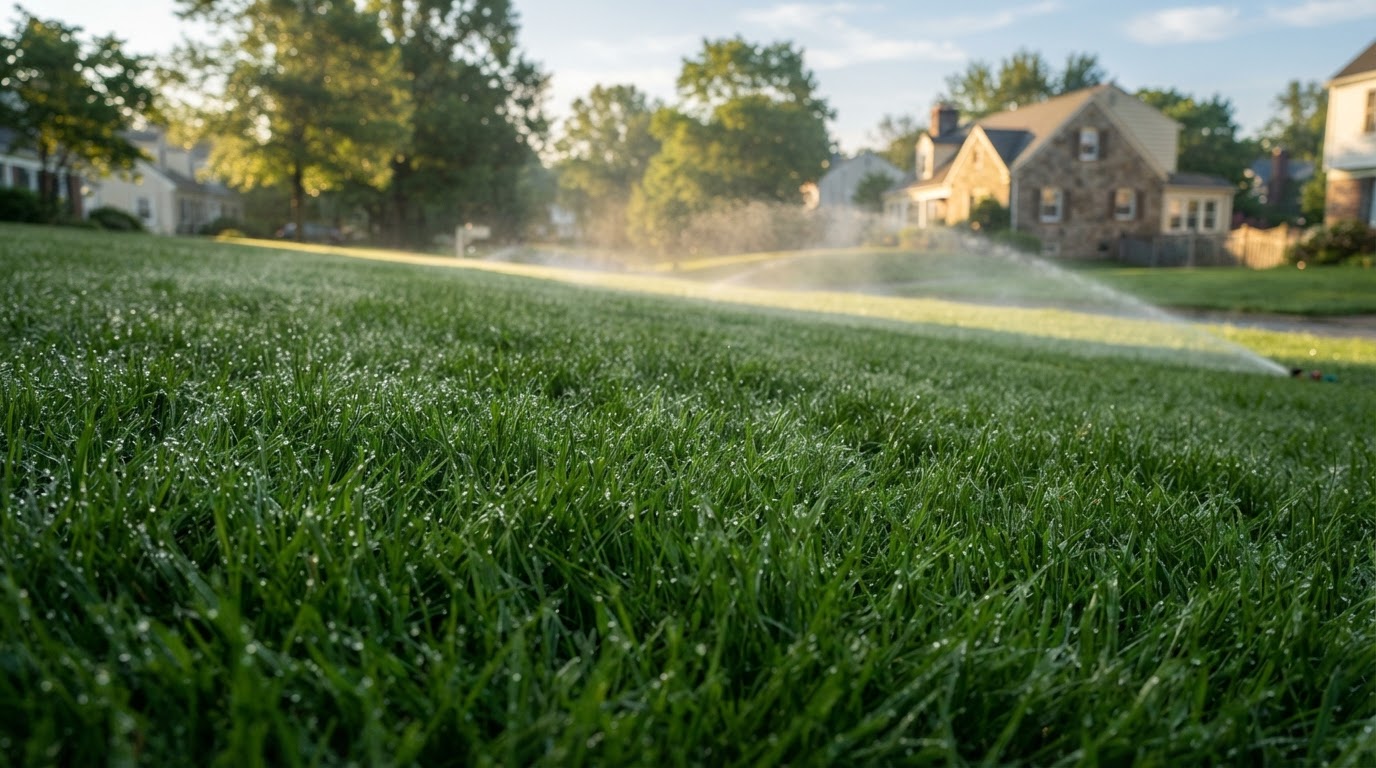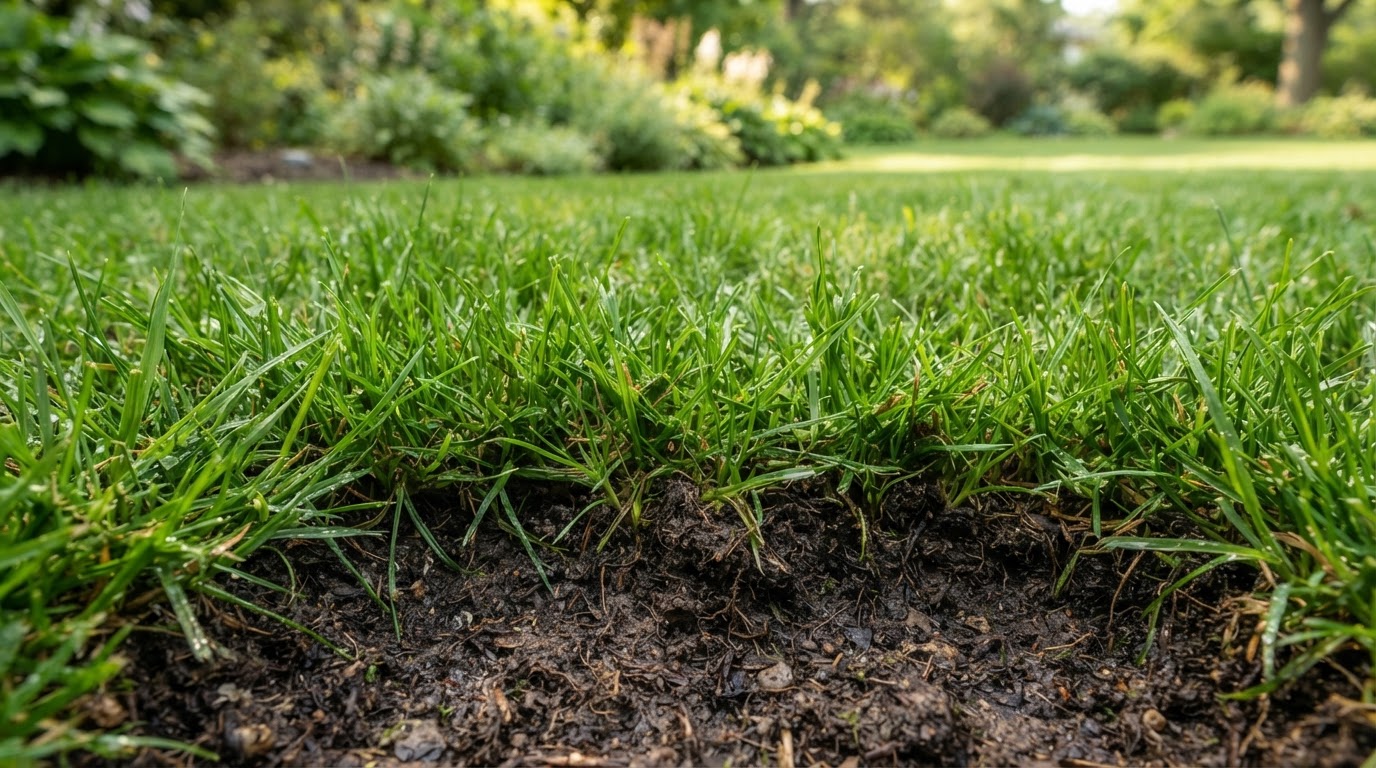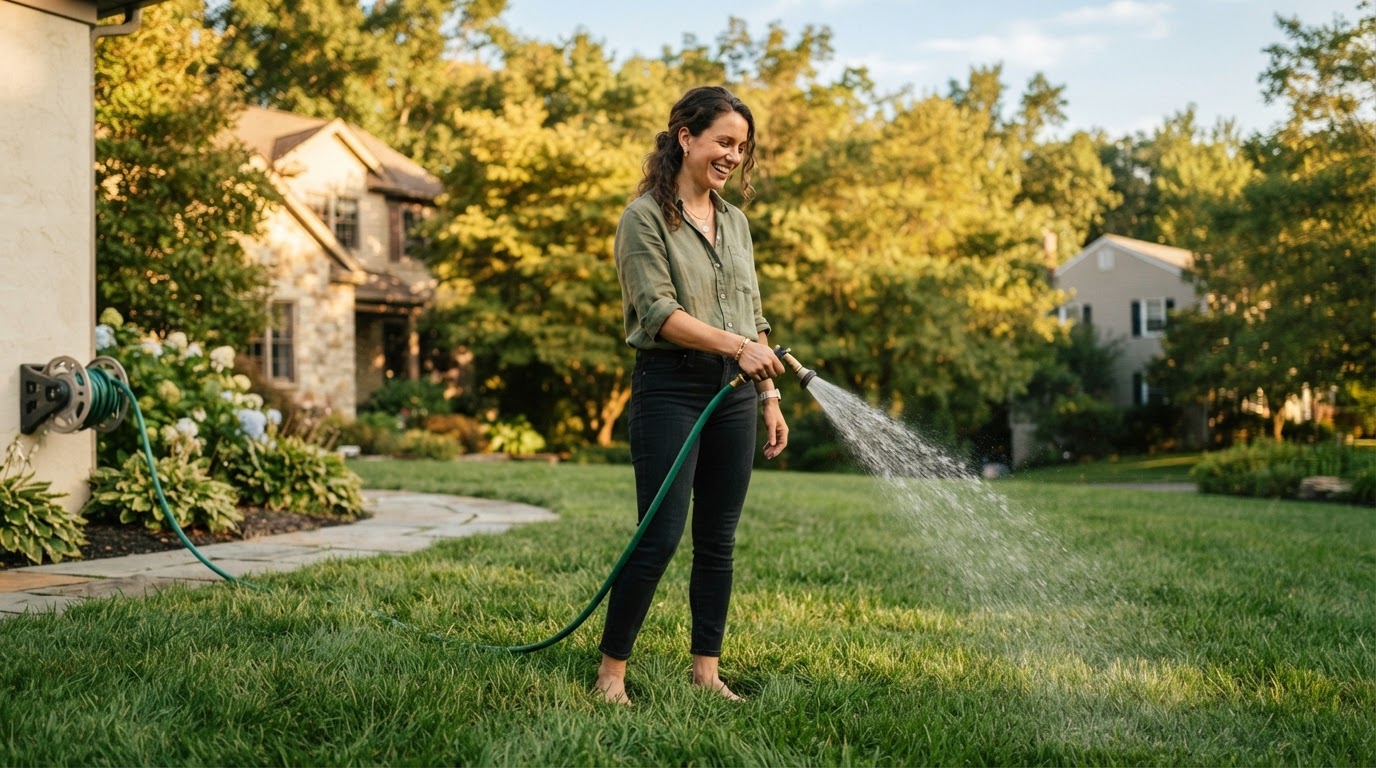
For an established, actively growing cool-season lawn, about one inch of water per week from rainfall and irrigation combined is a useful starting benchmark — not a requirement to apply an extra inch every week. Weather, soil, rooting, and the condition of the lawn determine whether supplemental watering is needed.
But that still leaves the question homeowners actually ask:
“How long should I leave the sprinkler running?”
Before I give you a number, I want to know what your sprinkler delivers. That is where an empty tuna can becomes surprisingly useful. Not because the can contains some lawn-care secret — it gives you a way to measure something you might otherwise be guessing about.
And at Golden Green, I would much rather help a homeowner understand the watering than simply say, “Your lawn needs more.”
“I Watered for Twenty Minutes” Tells Me the Time — Not the Amount
Imagine a homeowner standing beside a struggling lawn. They have been moving sprinklers, checking the grass, and trying to do everything correctly. Now somebody tells them the lawn might need water.
Naturally, their response is: “I already watered it.”
I understand the frustration. But two sprinklers running for the same amount of time can deliver very different amounts of water. Sprinkler type, pressure, condition, and placement affect what reaches the lawn.
Twenty minutes might be inadequate in one setup and sufficient for the intended application in another. So I would not automatically tell that homeowner to double the runtime. I would start by measuring.
The timer tells you how long the sprinkler ran. The cans help show what the lawn received.
Why the Tuna Can Trick Works
A shallow, straight-sided container catches sprinkler water. Measuring the depth tells you how much landed at that location during the test. Place several containers across the watering area, and you can also compare coverage. University of Georgia Extension describes this approach for both irrigation systems and hose-end sprinklers.
That gives us two useful questions:
- How much water is being applied?
- Is it being distributed reasonably evenly?
For me, the second question can be just as important as the first. A sprinkler running longer does not necessarily solve a dry corner if most of the additional water keeps landing somewhere else.
Do Not Wait for the Can to Fill
This is the detail that makes the test a measurement rather than another guess. Measure inches of water — not whether the container looks full. A quarter-inch, half-inch, or one-inch reading has meaning. “One full can” only has meaning if you know its depth.
Also, the test measures water delivered to the surface. It does not measure how far that water moved into the soil. University of Maryland recommends checking the soil after irrigation rather than assuming a measured surface application guarantees adequate penetration.
What did the sprinkler apply — and what happened to that water afterward?
Sprinkler Runtime Calculator
Turn your tuna-can test into an estimated watering time
Estimated sprinkler runtime
30 min(30 min)
Formula: test minutes × desired depth ÷ measured depth
Check coverage before increasing runtime everywhere — one dry can means uneven distribution, not necessarily “more water.”
If water runs off, divide the runtime into shorter cycle-and-soak intervals rather than running continuously.
This is an estimate based on your test, not an automatic watering schedule. Soil, slope, weather, and the lawn's stage still guide the final decision.
A Simple Example: Turning Minutes Into Inches
Suppose your cans collect an average of ¼ inch during a 15-minute test. Assuming the sprinkler output stays the same, the calculation is:
| Desired application depth | Estimated total runtime |
|---|---|
| ¼ inch | 15 minutes |
| ½ inch | 30 minutes |
| 1 inch | 60 minutes |
These are calculated examples — not watering instructions for every lawn. The general formula is:
Required runtime = test runtime × desired depth ÷ measured average depth
For the half-inch example:
15 minutes × 0.50 ÷ 0.25 = 30 minutes
That is the difference between saying, “I usually water for half an hour,” and saying, “This setup applies approximately half an inch in half an hour.” The second statement gives us something useful to work with.
What about the homeowner whose number is 52 minutes?
That is perfectly possible. But I still want to know:
“Fifty-two minutes to apply how much water?”
If your test shows that 52 minutes delivers half an inch, that is useful information. If 52 minutes merely fills an unidentified container, we still need a measurement. The number of minutes needs to be attached to a water depth.
Do the Cans Agree With Each Other?
Do not calculate an average and throw away the individual readings. Imagine one can collects half an inch while another collects only one-tenth of an inch during the same test. That is a meaningful difference. Increasing the runtime would add water to both locations. It would not, by itself, correct the distribution pattern.
I would first review sprinkler placement, overlap, obstructions, and equipment condition. University of Minnesota recommends irrigation audits that include checking components, testing performance, and adjusting the controller. Sometimes the lawn does not need the entire sprinkler system to run longer. It needs the water to reach the right places.
This is particularly worth checking when the same strip or corner struggles repeatedly.
Can You Use the Same Runtime Everywhere?
Treat the number as a starting point for the setup you tested — not a permanent prescription for the whole property. Recheck when you move to a different zone, change sprinklers, alter the spray pattern, use a different hose arrangement, or notice a change in coverage.
Even where delivery is similar, watering needs may differ between locations. Soil, sunlight, rooting, and weather still influence the decision. University of Minnesota advises adjusting irrigation to conditions rather than relying on a “set it and forget it” schedule.
I would write down the setup as well as the number: front lawn, sprinkler position, test duration, average depth, and date. That creates a useful reference without pretending conditions never change.
How Much Water Does the Lawn Need This Week?
Once you know the sprinkler’s output, decide whether — and how much — you need to irrigate. For many established cool-season lawns being maintained in active growth, around one inch of total weekly water is a useful starting reference. Purdue’s regional guidance uses approximately one to 1½ inches, depending on conditions. Neither number means every property needs that amount of added irrigation every week. Rainfall counts.
Suppose the working target for a particular week is one inch, and the lawn receives half an inch of useful rainfall. The remaining amount would be approximately half an inch — not another full inch. That subtraction is only a starting estimate. Check the soil, especially after a brief downpour that may have produced runoff rather than thorough soaking.
Keeping a lawn green and keeping it alive are different goals
An established cool-season lawn may enter dormancy during hot, dry weather rather than remain lush throughout summer. Allowing dormancy can be a reasonable choice, but prolonged drought still requires attention to plant survival. Discuss the goal before deciding how much water to use.
What Does “Water Deeply” Actually Mean?
It does not mean, “Keep watering until the surface is soggy.” It means applying enough water to moisten the usable root zone without unnecessarily saturating the soil or sending water off the property.
University of Massachusetts guidance commonly uses four to six inches of soil wetting as a reference for established turf, while noting that the amount of water required varies with soil conditions. After the water has had an opportunity to soak in, check representative locations with an appropriate soil probe or small trowel. Observe the actual soil moisture. Do not assume that an easy-to-insert screwdriver tells the whole story; resistance can also reflect the soil’s physical condition. Be careful around shallow irrigation components and other buried features.
A measured inch in a container is an application measurement — not a promise of a particular rooting depth.
Why Quick Daily Sprinkling Can Be a Problem
For established turf, frequent shallow watering can leave the lawn dependent on moisture near the surface. Deeper, less frequent irrigation can support better use of the soil’s moisture reservoir when the soil and root system permit it. That does not make one watering schedule suitable for every site.
I also want to be careful with the phrase “roots follow water.” Penn State explains that roots do not literally search for water. They grow more vigorously where conditions are favorable. Soil temperature, moisture, and oxygen all affect root development. That matters because a longer sprinkler run cannot force roots through every compacted or oxygen-poor layer.
Watering helps create conditions for roots. It does not replace all the other conditions roots need.
What If Water Starts Running Down the Driveway?
Pause. Water leaving the lawn is not accomplishing the job we intended. On slopes or slowly absorbing soil, divide the irrigation into shorter applications separated by time for infiltration. This is often called cycle-and-soak watering. It can help deliver the intended amount without applying water faster than the soil can absorb it.
For example, a calculated runtime may need to be divided into several cycles. The appropriate cycle length and soaking period depend on the property. Do not assume every lawn can accept a full calculated application continuously. And do not confuse several cycles within one watering event with lightly sprinkling the lawn every day.
The objective is absorption — not uninterrupted runtime.
Morning Watering Usually Makes the Most Sense
When irrigation is needed, early morning generally offers favorable conditions: less evaporation and wind disturbance, while allowing foliage to dry during the day. University of Minnesota recommends morning irrigation and avoiding unnecessarily prolonged leaf wetness. That does not mean a single afternoon watering will automatically damage the lawn. It means I would prefer a planned morning application over repeatedly keeping the grass wet late into the night. Always work within applicable local watering restrictions.
The Important Exception: Newly Seeded Lawns
Do not use an established-lawn watering schedule for newly germinating seed. This is especially important after overseeding.
New seedlings can dry out quickly. During germination and early establishment, the seedbed may need several light applications to maintain suitable moisture without ponding or washing seed away. As roots develop, watering can gradually become deeper and less frequent. The tuna-can test still helps you understand delivery. But the amount and frequency must fit the establishment stage.
The same distinction applies when establishing Sunny Seed Mix. Do not stop establishment care merely because the fastest part of a mixture has appeared. Slower-establishing grasses may still need that support.
Established grass and new grass can be on the same property while needing different watering decisions.
Recognize Stress Without Assuming Every Brown Patch Needs Water
A blue-gray cast, folded leaves, or footprints that remain visible can indicate moisture stress. Check the soil and the pattern before deciding what to do. At Golden Green, I do not want a quick glance at brown grass to become an automatic recommendation for more irrigation — or more fertilizer. I want to know what is happening.
Is coverage uneven? Is the surface wet but the soil below it dry? Is the area staying saturated? Did the problem begin after mowing or another disturbance? Penn State explains that excessive water can reduce soil oxygen and harm roots, just as insufficient moisture limits the plant.
A struggling lawn needs an explanation, not a reflex.
How This Fits With the Rest of Your Lawn Care
Watering belongs in the same conversation as mowing, nutrition, soil conditions, and turf selection. For example, suitable mowing height and appropriate fertility can affect lawn quality and irrigation requirements. Grass species also differ in their water use and ability to tolerate dry conditions. That is why I want Golden Green’s fertilization program connected to the way a lawn is actually maintained. If rain is in the forecast around a scheduled treatment, our guide to fertilizing before or after rain in Pennsylvania explains why fertilizer-only and weed-control visits can call for different watering decisions.
Where compaction is a concern, we may discuss mechanical core aeration. Penn State describes core aeration as a practice used to alleviate compaction and create channels through the turf. It is not a universal repair for every drainage problem. Where soil chemistry or nutrition is uncertain, soil testing may answer a different set of questions. The point is not to sell every service. It is to identify which part of the system needs attention.
Golden Green’s Practical Watering Checklist
Before the next sprinkler run, ask:
| Check | What you need to know |
|---|---|
| Measure delivery | How much water does this setup apply in a measured time? |
| Compare coverage | Are some areas receiving substantially less than others? |
| Account for rainfall | What water has the lawn already received? |
| Check the soil | Is irrigation needed, and is the water soaking into the root zone? |
| Prevent runoff | Does the application need to be divided into shorter cycles? |
| Identify the lawn's stage | Is this established turf, new seed, or recently installed sod? |
| Review current conditions | Does today's weather and soil moisture justify watering? |
A timer is useful. It should carry out the decision — not make the decision by itself.
What Should You Expect After Improving the Watering?
The first benefit should be a clearer understanding of your sprinkler and coverage. You may discover that one section receives much less water than you assumed. You may find that the sprinkler applies water faster than the soil can absorb it. Or you may learn that rainfall has already done the work you were about to repeat.
I would not promise that one deep watering fixes a weak lawn or that a particular number of weeks guarantees deeper roots. But measuring gives us something concrete to adjust. Over time, we can evaluate whether the lawn is responding and whether something else needs investigation.
Better information should lead to better decisions — not a more complicated set of guesses.
An Old-School Trick With a Useful Purpose
I like the tuna-can test because the idea is accessible. You do not need to start with a complicated irrigation discussion. You can begin with a few containers, a ruler, and a timer. Then you know more than you did before. That fits the kind of lawn care I want Golden Green to provide throughout Eastern Pennsylvania.
Whether the property is in Emmaus, Macungie, Allentown, Sellersville, or another community we serve, I want the homeowner to understand the recommendation. Not simply, “Water more.” Not, “Run every zone for the same number of minutes.”
Measure what is delivered. Check where it goes. Adjust to what the lawn needs.
That is how an empty tuna can becomes a useful lawn-care tool. Golden Green — Your Lawn’s Best Friend.