📸 Picture Your Weed, We'll Spray It For Free!No credit card required.Claim Offer →
    Fertilization Schedule · Eastern PA

    What Is the Best Lawn Fertilization Schedule in Pennsylvania?

    Why Golden Green's six-step program shifts between Step 4 and Step 5 — and why that “strategic shift” toward fall aeration and overseeding is the most important decision of the entire lawn-care season.

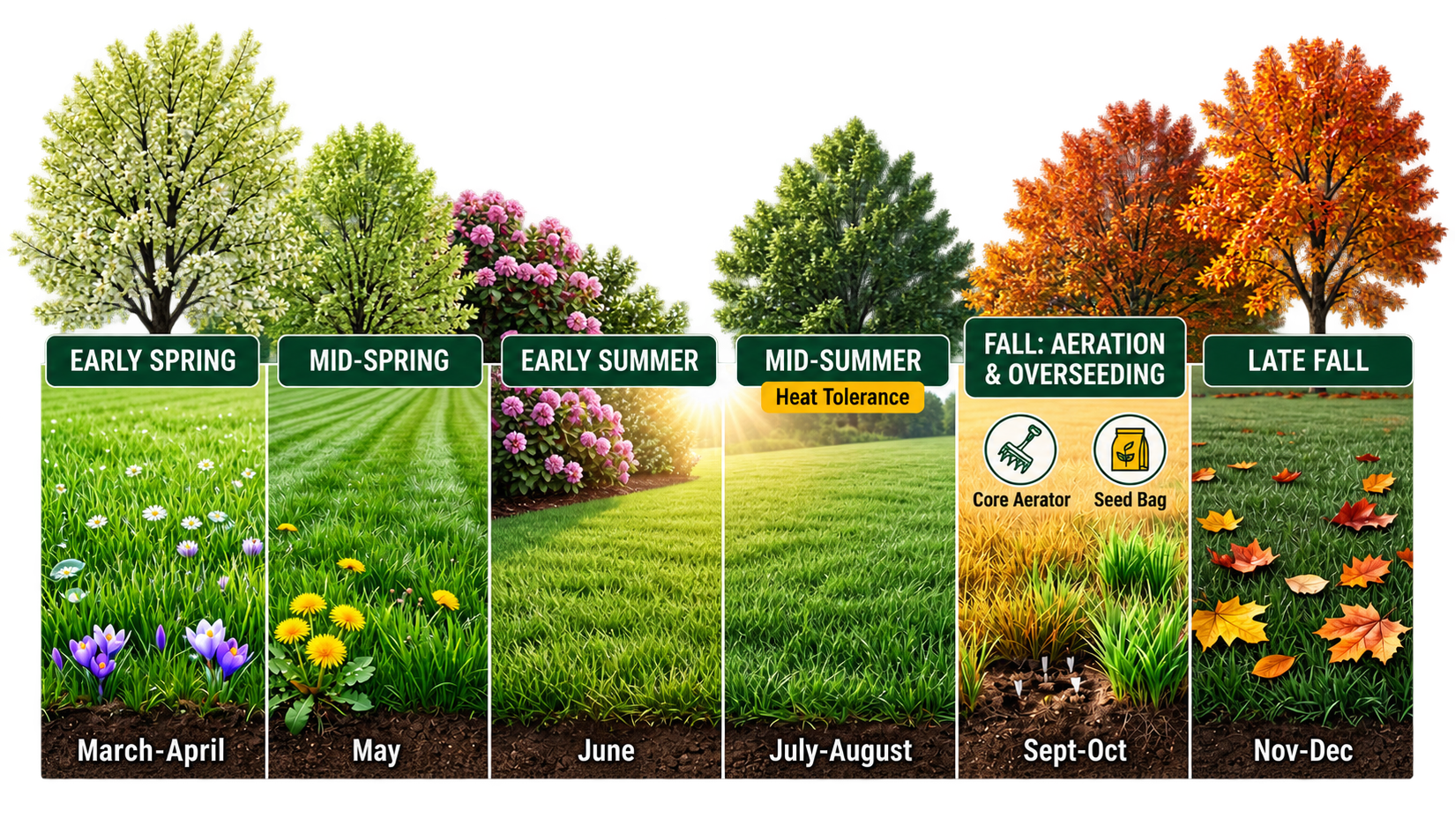
    A healthy cool-season Pennsylvania lawn divided into six seasonal sections representing a lawn fertilization schedule

    If you're on a professional lawn fertilization program in Pennsylvania, you may notice something interesting when late summer and early fall arrive.

    For most of the season, your lawn-care visits can feel fairly predictable. Step 1. About five to six weeks later, Step 2. Another five to six weeks, Step 3. Then Step 4.

    But sometime between Step 4 and Step 5, the rhythm may change a little. You may look at your calendar and wonder:

    Where is my next lawn fertilization application?

    Meanwhile, Golden Green trucks are busy doing something else throughout neighborhoods in Eastern Pennsylvania: aerating and overseeding lawns.

    Did we forget about Step 5? Is your lawn fertilization schedule in Pennsylvania getting behind? Should you be concerned?

    Usually, no. What you're seeing is a strategic shift that happens during one of the most important windows of the entire lawn-care season.

    Fall aeration and overseeding season has arrived. And at Golden Green, we take that window very seriously.

    How Does a Six-Step Program Work?

    Golden Green's six-step lawn fertilization program is designed around the growing season of cool-season lawns in Pennsylvania. The season begins in early spring and finishes in late fall as the turf prepares for winter.

    1
    Early Spring

    Wake-Up & Early Management

    Begins the season as cool-season turf starts waking up, with early weed and crabgrass management.

    2
    Spring

    Active Growth

    As temperatures increase and the lawn enters active spring growth, we continue fertilization and weed control.

    3
    Summer

    Stress Management

    Accounts for heat, inconsistent rainfall, insects, disease pressure and other environmental stress.

    4
    Late Summer / Early Fall

    Recovery Transition

    Helps support the lawn as it comes out of summer stress and enters the important fall growing season.

    5
    Fall

    Prime Growth Support

    Once the aeration and overseeding rush is under control, we continue the fall fertilizer program.

    6
    Late Fall

    Winter Preparation

    Closes out the seasonal program as the growing season winds down and winter approaches.

    Aeration and Overseeding Season sits right between Step 4 and Step 5 — the special window this article is all about.

    How Often Should You Fertilize a Lawn in Pennsylvania?

    One of the most common questions homeowners ask is: When should I fertilize my lawn in Pennsylvania?

    Throughout much of our six-step program, Golden Green generally works around an interval of approximately five to six weeks between applications. But that's a general framework. It isn't a stopwatch.

    We aren't standing beside your lawn saying,“It's Day 36. The grass must be fertilized today.”

    Plants don't work that way. Neither does Pennsylvania weather. Rainfall matters. Temperature matters. Soil conditions matter. Turf condition matters. And during the fall, aeration and overseeding matter.

    That's why a good lawn fertilization schedule in Pennsylvania needs enough structure to keep the lawn properly managed while still allowing enough flexibility to respond to actual conditions.

    Why Is There Sometimes a Bigger Gap Between Step 4 and Step 5?

    Let's say you've received Step 4. Normally, you're expecting us again in approximately five to six weeks. But now we're in September.

    Instead of being obsessed with making every fertilization interval identical, we may strategically shift more technician capacity toward aeration and overseeding. Maybe the normal five-to-six-week interval stretches somewhat longer. That's not a mistake.

    4

    Late Summer Recovery

    strategic shift

    Aeration & Overseeding Window

    5

    Fall Program Resumes

    I don't really like calling it a delay. I think strategic shift describes it much better.

    Interactive Tool

    Build Your Pennsylvania Treatment Calendar

    Pick the date your lawn's season typically kicks off and we'll map out an approximate six-step schedule — including the extended aeration & overseeding window that stretches the gap between Step 4 and Step 5. Actual timing always follows the lawn and the weather.

    Strategic shift detected: the gap between Step 4 and Step 5 is about 70 days — roughly double the normal interval — because that's when aeration & overseeding take priority.

    1
    Early Spring

    Wake-Up & Early Management

    Fri, Mar 20, 2026
    2
    Spring

    Active Growth

    Mon, Apr 27, 2026
    3
    Summer

    Stress Management

    Thu, Jun 4, 2026
    4
    Late Summer / Early Fall

    Recovery Transition

    Sun, Jul 12, 2026
    5
    Fall

    Prime Growth Support

    Sun, Sep 20, 2026
    6
    Late Fall

    Winter Preparation

    Wed, Oct 28, 2026
    Strategic Shift
    Aeration & Overseeding

    All Hands on Deck Window

    Falls between Jul 12 and Sep 20 — the busiest stretch of the year.

    This calculator uses approximate 38-day intervals (about 5.5 weeks) with an extended 70-day gap before Step 5. Real visits shift with rainfall, temperature, soil conditions and turf health. Want a schedule built around your actual lawn? Explore Golden Green's fertilization program.

    Interactive Turf Tracker

    Month-by-Month Turf & Soil Status in Pennsylvania

    Tap any month to see what's happening underground. Soil temperature drives root development — and root development drives every decision in a seasonal lawn fertilization program. Watch how the September–October window becomes the best root-building period of the entire year.

    9

    September

    Turf Status: Recovering
    Soil Temp
    65°–72°F
    32°F82°F
    Root Development

    Root recovery begins as soil cools. New root initiation accelerates — a key fall window.

    Shoot Growth

    Color returns and growth resumes as nights cool and dew returns.

    Overall Turf Activity60%

    Step 4 + aeration & overseeding season. The most valuable improvement window of the year.

    Legend:DormantWaking UpActive GrowthPeak GrowthHeat StressedRecovering

    Why Golden Green Prioritizes Fall Aeration and Overseeding

    I've worked on enough lawns over the years to become convinced of something: fertilizer can only do so much. Don't misunderstand me — lawn fertilization is extremely important. It's the backbone of our program. But fertilizer has a limitation.

    Fertilizer feeds the grass you already have. Seed gives you an opportunity to change the grass you have.

    If your lawn is thin, we can fertilize those existing plants. If there's a bare area, we can fertilize around it. But fertilizer can't magically create a desirable new grass plant where one doesn't exist.

    You can fertilize an empty spot all year. It's still an empty spot until something grows there.

    That's why fall aeration and overseeding are so important. Summer shows us the weaknesses. Fall gives us the opportunity to work on them.

    Why We Don't Want to Miss the Pennsylvania Seeding Window

    If one of our fall lawn fertilizing routes needs to move slightly, we often have some ability to adjust the remaining schedule appropriately. But we cannot keep pushing grass establishment later and later indefinitely. The season is changing. Winter is eventually coming.

    We can adjust a fertilization route. We can't tell December to wait.

    Aeration Season Is Like UPS at Christmas

    Here's probably the best analogy I can give you for what happens inside Golden Green during fall aeration season. Think about UPS at Christmas.

    UPS delivers packages all year. Then the Christmas season arrives. Suddenly, package volume explodes. Everyone wants the same thing: get the package to the front door before Christmas. It's all hands on deck. That's how I think about fall aeration and overseeding at Golden Green.

    Package Volume Over the Year
    January
    steady
    March
    steady
    June
    steady
    August
    steady
    October
    steady
    Aeration Season
    ALL HANDS
    volume explodes — all hands

    Just like UPS at Christmas, Golden Green redirects capacity during the fall aeration & overseeding rush — without abandoning the rest of the program.

    What Happens to Step 5?

    We don't forget about it. Your lawn fertilization program is still moving forward. You've already received Step 4, which helped support the lawn as it transitioned out of summer stress.

    As the aeration rush winds down, we shift technician capacity back toward the remaining fall applications. The objective isn't to make every interval mathematically identical — it's to complete the right work during the right seasonal opportunity.

    Not this: fertilization OR aeration and overseeding.

    But this: fertilization AND aeration AND overseeding — each performed when it provides the most value.

    A Good Fertilizer Schedule Has to Follow the Lawn

    I think homeowners sometimes expect professional lawn care to operate like an oil-change sticker. You hit a certain date, you perform the service, then you count the days until the next one. But we're managing living plants growing outside. A Pennsylvania lawn doesn't care what our spreadsheet says.

    What the Lawn Needs by Season
    Early Spring
    Wake-up & early management
    Spring
    Active growth & weed management
    Summer
    Managing fertility under stress
    Late Summer / Fall
    Recovery & improvement
    Late Fall
    Finish the season for winter

    One September can be completely different from another. That's why I believe the best fertilizer schedule in Pennsylvania combines consistency with judgment. We need a plan. But we also need to be willing to respond to the lawn.

    Spring, Summer & Fall Fertilizer Have Different Jobs

    Spring

    Works with turf entering active spring growth.

    Summer

    Accounts for the stresses of warmer weather.

    Fall

    Supports recovery and an important growth period.

    The applications belong to the same program. But the lawn's needs change throughout the year. That's why we call it a seasonal lawn fertilization program. We're following the season.

    What About Weed Control During Aeration and Overseeding?

    This requires additional care. Homeowners sometimes think: “Why can't you simply spray every weed while you're here?” Because we're also trying to establish grass seed. Certain herbicides and pre-emergent products can have restrictions involving seeding or newly established turf.

    That's why Golden Green coordinates weed-control decisions with the aeration and overseeding plan. Sometimes the correct decision is not spray everything — sometimes it's protect the seeding opportunity. The exact product label controls.

    Step 4 Helps Bridge the Summer-to-Fall Transition

    I think of it as a sequence:

    Summer StressStep 4Aeration & OverseedingStep 5Step 6Winter

    When you see the program this way, that slightly different interval between Step 4 and Step 5 makes much more sense. Read more in our Step 4 treatment guide.

    Fertilization Maintains the Lawn. Seed Can Help Change It.

    Suppose you have a lawn that's been on a Pennsylvania lawn fertilization program for four years. The color improves. The weeds are managed. But every August it becomes thin and disappointing again. At some point I have to ask: do we simply need to keep feeding this lawn, or do we need to improve what's actually growing here?

    That's where aeration and overseeding become so important. With Sunny Seed Mix, we're trying to introduce desirable turfgrass varieties and gradually improve the overall stand. No seed is magic. No grass is indestructible. But better turf gives us a better foundation.

    Want to go deeper on timing? Read our article on how often you should fertilize your lawn in Pennsylvania.

    Does Every Pennsylvania Lawn Need Aeration Every Year?

    No. Some lawns are already thick. Some have excellent turf. Some have little compaction. Golden Green isn't interested in telling every homeowner that every lawn automatically needs every service.

    The lawn determines the recommendation.

    What If My Step 5 Application Seems Later Than Expected?

    Ask us. I want Golden Green customers to understand what's happening on their lawns. If something doesn't make sense, I don't want you sitting at the kitchen table wondering: “Did they forget me?”

    We didn't forget you. If we're in the middle of fall aeration and overseeding season, there's a good chance our technicians are working through one of the most intense production windows of the entire year.

    What Is the Best Lawn Fertilization Schedule in Pennsylvania?

    After years of working on lawns, my answer is this: the best lawn fertilization schedule is structured, seasonal and flexible enough to respond to the actual lawn. The calendar guides us. The lawn makes the final decision.

    The goal isn't to create the prettiest lawn-care calendar. The goal is to create the best lawn.

    Feed the lawn. Control the weeds intelligently. Watch the weather. Improve the soil. Build better turf. And when fall gives us a short opportunity to aerate and overseed? It's all hands on deck.

    Golden Green — Your Lawn's Best Friend.

    Frequently Asked Questions

    Golden Green uses a six-step seasonal lawn fertilization program, generally targeting approximately five-to-six-week intervals through much of the growing season. Actual timing can vary according to weather, turf conditions, application requirements and seasonal priorities.

    There isn't one exact interval appropriate for every lawn or product. Golden Green generally works around five-to-six-week intervals within its six-step program while adjusting for the season, weather and lawn conditions.

    Pennsylvania cool-season lawns have different needs from early spring through late fall. A seasonal program should account for spring growth, summer stress, fall recovery and winter preparation rather than applying identical treatments throughout the year.

    Late summer and early fall provide an important window for aerating and overseeding cool-season lawns. Golden Green may strategically shift technician capacity toward completing this time-sensitive work before returning greater capacity to Step 5.

    Golden Green considers Step 4 a late-summer/early-fall transition application that helps support cool-season turf as it begins recovering from summer stress.

    The appropriate sequence depends on the lawn, fertilizer, herbicides being used, seeding plan and individual product labels. Golden Green coordinates fertilization, weed control, aeration and overseeding rather than treating them as unrelated services.

    Some herbicides and pre-emergent products have restrictions involving seeding or newly established turf. Always follow the exact product label and coordinate weed-control applications with planned overseeding.

    Yes. Fall is an important growth and recovery period for Pennsylvania cool-season lawns. Fertility should be based on turf needs and an appropriate seasonal program.

    They perform different jobs. Fertilizer supplies nutrients to existing turfgrass. Mechanical aeration can help manage compaction, while overseeding introduces new desirable grass plants. A struggling lawn may need all three as parts of a larger improvement strategy.

    No. It depends on turf density, compaction, grass composition, lawn condition and the homeowner's goals.

    A six-step structure allows Golden Green to manage the lawn across changing Pennsylvania seasons rather than treating spring, summer and fall as if the turf had identical needs throughout the year.

    Not Sure What Your Lawn Needs This Season?

    Whether it's fertilization, aeration, overseeding, or weed control — let Golden Green take a look and build the right seasonal plan for your Pennsylvania lawn.

    Build My Lawn Care Plan

    Share this article

    Share this article

    Keep Reading

    Golden Green Fertilization & Weed Control

    Why Step 4 Helps PA Lawns Bounce Back

    How Often Should You Fertilize a PA Lawn?

    Mechanical Core Aeration

    A Complete Guide to Overseeding in Eastern PA

    Sunny Seed Mix

    CALLTEXT