Aftercare Field Guide
When Can You Mow After Aeration and Overseeding in Pennsylvania?
By the Golden Green Team
“The seed is down. I’m watering. But the old grass is getting tall. Can I mow this week?”
That is a fair question—and one I would rather discuss before someone drives across a freshly seeded lawn.
My answer starts with another question: What is happening on the ground?
An established lawn with new seed worked into it is different from a thin, muddy area where you are trying to build grass almost from scratch. The mowing decision needs to account for that difference.
After years of working on lawns, I think the most useful advice is also the least glamorous: protect the work you just paid for.
That means paying attention to moisture, new growth, footing, and how the lawn will be cut. The calendar matters, but it cannot make those decisions by itself.
The short answer: conditions first, calendar second
There is no universal five-day, seven-day, or two-week rule for mowing after aeration and overseeding.
For an established lawn, a careful cut may be appropriate while new seed is still establishing, provided conditions support it. For mostly bare or newly renovated areas, the first cut should follow the development of the new grass.
Penn State recommends using a lightweight mower and judging new turf by its growth and ability to withstand the mower and operator. As an example, its establishment guidance suggests beginning just before the grass reaches four inches when the intended cutting height is three inches. That example is not a required height for every seed mixture.
Source: Penn State Extension’s lawn establishment guidance
My practical rule: do not let a mowing appointment override what the lawn is showing you.
First, which kind of lawn are we talking about?
Existing lawn + new seed
You still have established grass growing around the new seed.
That existing cover provides some protection, but it does not make the seedlings indestructible. Thin patches, soft spots, and turning areas still deserve special attention.
You also cannot assume that stopping all mowing for several weeks is automatically helpful. Purdue’s overseeding guidance includes continued mowing to limit competition from the established turf.
Source: Purdue Extension’s lawn improvement guidance
The question becomes: can we manage the established grass without unnecessarily disturbing the new work?
Mostly bare ground + new seed
There is much less existing turf to support traffic or protect the surface.
I would be more cautious here. A wheel can leave a rut. A turn can scuff the surface. A footstep can disturb a soft patch before there is much grass holding it together.
Treat this as new-lawn establishment, not simply an overdue mowing visit. Extensive bare areas may also need preparation beyond routine aeration and overseeding.
One property can contain both situations. The front lawn might be ready for a gentle cut while a repaired side yard needs more time.
Four situations I would handle differently
| What you see | What concerns me | What I would do |
|---|---|---|
| Established grass needs cutting; footing is firm; seeded patches are protected | Letting existing growth become difficult to manage | Evaluate a careful cut and avoid vulnerable areas |
| Soil is squishy, wheels leave marks, or muddy material builds up | Rutting and disturbance from traffic | Postpone mowing there and reassess watering and drainage |
| Seed is exposed on dry, loose ground | Poor establishment conditions and unnecessary disturbance | Address seedbed conditions before treating mowing as the priority |
| Mostly bare ground has small, fragile seedlings | Traffic before the young turf can tolerate it | Wait for suitable growth and surface conditions; get specific guidance if uncertain |
What you see
Established grass needs cutting; footing is firm; seeded patches are protected
What concerns me
Letting existing growth become difficult to manage
What I would do
Evaluate a careful cut and avoid vulnerable areas
What you see
Soil is squishy, wheels leave marks, or muddy material builds up
What concerns me
Rutting and disturbance from traffic
What I would do
Postpone mowing there and reassess watering and drainage
What you see
Seed is exposed on dry, loose ground
What concerns me
Poor establishment conditions and unnecessary disturbance
What I would do
Address seedbed conditions before treating mowing as the priority
What you see
Mostly bare ground has small, fragile seedlings
What concerns me
Traffic before the young turf can tolerate it
What I would do
Wait for suitable growth and surface conditions; get specific guidance if uncertain
The same number of days can lead to a different decision on each lawn.
A sunny area in Macungie may dry differently from a shaded corner in Bethlehem. A well-covered lawn in Emmaus may tolerate a careful pass better than an exposed repair area in Allentown or Quakertown.
That is why I want homeowners thinking about their particular lawn.
Water for the seed—not for the stopwatch
I understand the appeal of a simple instruction like “water for 10 to 20 minutes every morning.”
But minutes do not tell us how much water reached the soil. Sprinklers differ, and rain changes the requirement.
During germination, aim for consistent seedbed moisture without saturation or runoff. In drying weather, several light watering cycles may be necessary; one morning cycle may not be enough. Adjust to actual conditions, then gradually change the watering pattern as the grass establishes.
Too dry: the seedbed is drying out.
Moist seedbed + firm footing: a better combination for establishment and evaluating access.
Saturated: puddles, squishing, or surface movement mean traffic should wait.
Read our Pennsylvania lawn-watering guide for the distinction between caring for new seed and watering established turf.
Why I am cautious about mowing a wet, freshly seeded lawn
Here is the situation I want to avoid: we aerate and seed, the homeowner keeps adding water, and the lawn turns soft. Then a mowing visit proceeds because it is the usual day.
Now the aftercare problem becomes a traffic problem.
A lighter walk-behind mower may be easier to manage than a heavy riding mower on a delicate area. But lighter does not mean harmless. If the surface cannot support it, it still needs to stay off.
Zero-turn equipment deserves particular care around fresh seeding. Tight pivots and repeated turns can scuff vulnerable areas. This is about the conditions and the way equipment is operated, not a blanket criticism of a mower type.
My concern is straightforward: do not turn a lawn-improvement project into a rut-repair project.
If the ground stays soft, discuss the mowing plan with the person who performed the seeding. Do not deliberately dry out germinating seed just to make a scheduled mowing visit possible.
What about the soil plugs?
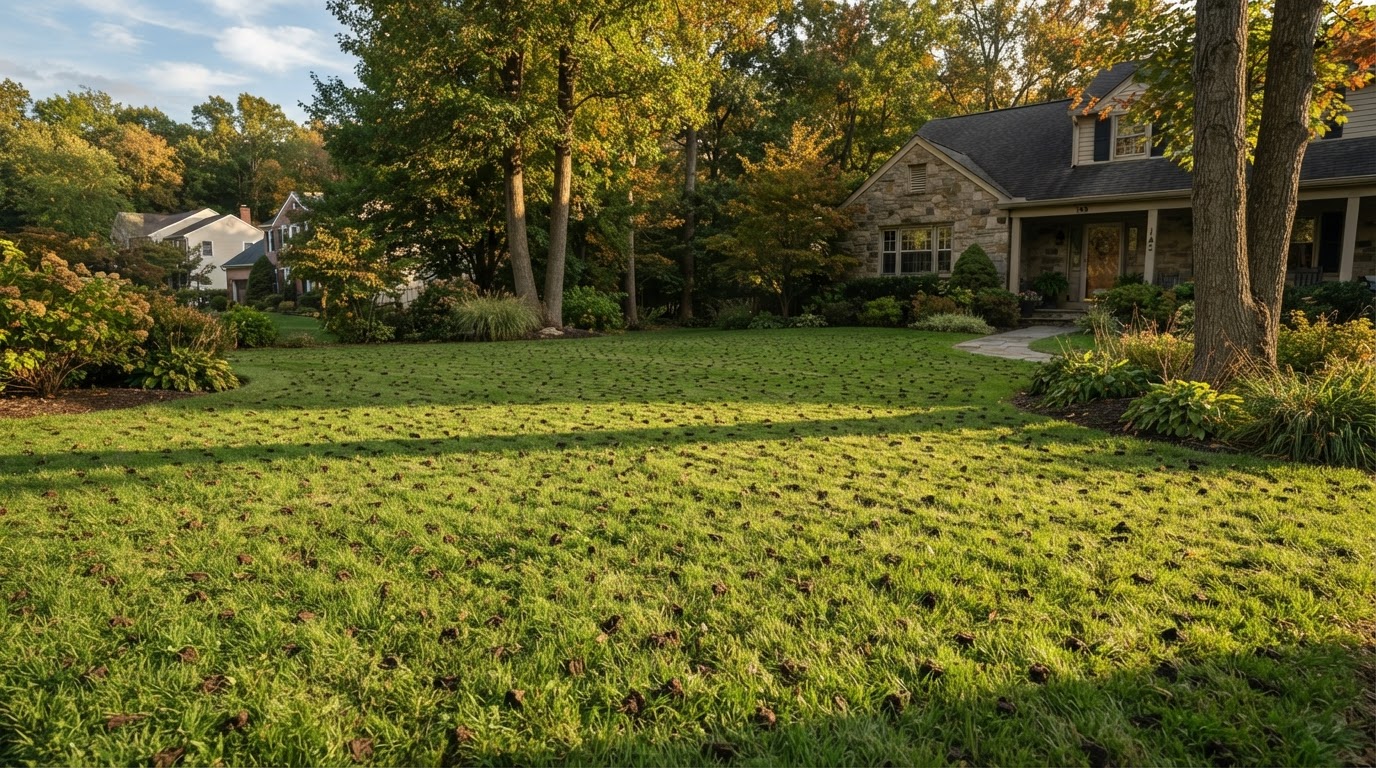
Those little cores sitting on the lawn are a normal part of mechanical core aeration.
They do not all disappear on the same schedule. Soil type and conditions affect how quickly they break apart; Colorado State notes that this can take days to several weeks.
Source: Colorado State Extension’s turf management guidance
I would not promise that seven mornings of watering will dissolve every plug—or make the lawn ready for mowing.
Plug breakdown and seedling readiness are different things.
Leave the cores to break down naturally rather than aggressively working over a newly seeded lawn just to make it look tidy.
If material is smearing and sticking during a proposed mowing pass, I would stop and reassess. But a few visible plugs are not, by themselves, a reason to stop mowing indefinitely.
Can mower airflow move grass seed?
My concern is loose, exposed seed and unnecessary disturbance.
A rotary mower creates airflow, but I would not claim that every pass moves a predictable amount of seed. The outcome depends on the mower, its setup, the surface, and how well the seed is in contact with soil.
I am not suggesting the seed will fly off your property. I am saying there is little value in making avoidable passes across loose, freshly seeded ground.
At Golden Green, we use equipment that aerates and applies seed during the same operation. I like coordinating those jobs because seed-to-soil contact matters.
That does not mean every seed lands in an ideal location, or that getting seed into an aeration hole guarantees germination. Preparation, seed placement, weather, and aftercare still work together.
Our overseeding service and Sunny’s Seed Mix information explain those parts of the process.
“The goal is to keep the established lawn manageable while giving the new grass a fair chance.”
— Geoffrey, Golden Green
What I mean by “check it around the first week”
I understand wanting a date to put on the calendar.
Around the first week can be a useful time to reassess an established overseeded lawn. It is not automatic permission to mow, and it is not a universal minimum waiting period.
Look at what has changed. Is the existing grass ready for attention? Are the thin areas still delicate? Will the proposed route avoid them?
For newly established turf, Penn State describes checking whether plants recover upright after a step. Plants that remain flattened may be too vulnerable to traffic. Make any assessment gently from an accessible edge rather than repeatedly walking across new growth.
Schedule a check, not a guaranteed first cut.
Readiness decision diagram
A planning aid—not an automatic mowing clearance.
- 1
Soil muddy, squishy, or ruts underfoot?
Yes → Postpone mowing there.
No → Continue to step 2.
- 2
Ground firm, but mostly bare with fragile young seedlings?
Yes → Wait for appropriate growth and traffic tolerance.
No → Continue to step 3.
- 3
Ground firm and established grass needs cutting?
Yes → Evaluate a gentle cut while avoiding vulnerable seeded patches.
No → Continue to step 4.
- 4
Unsure whether the available equipment can avoid damage?
Yes → Ask the seeding provider before proceeding.
When you do mow, make it a gentle first visit
Before starting, agree on a suitable cutting height for the grass and establishment plan. Then keep the job controlled:
- —Use a sharp blade.
- —Avoid scalping and drastic reductions in height.
- —Make gradual turns on stable areas.
- —Avoid repeated passes simply to improve the stripe pattern.
- —Keep wheels away from vulnerable repairs.
- —Stop if the lawn begins to rut, smear, or tear.
- —Avoid leaving heavy clipping piles over young grass.
The first cut does not need to win a neighborhood striping contest.
For the blade side of the job, read why dull mower blades can leave grass looking brown.
For clipping management, see when to return grass clippings and when to remove the excess. During establishment, avoid turning cleanup into another round of aggressive traffic.
Send this to your mowing company
That short conversation is worth having.
The person applying seed, the person watering, and the person mowing should not be working from three different plans.
This week / As the lawn establishes
This week
- —Check the seedbed and weather rather than repeating an irrigation schedule automatically.
- —Tell your mowing contractor which areas were seeded.
- —Identify soft patches and areas that should be avoided.
- —Contact the seeding provider if existing grass is becoming difficult to manage before the vulnerable areas are ready.
As the lawn establishes
- —Adjust mowing to actual growth and the agreed establishment plan.
- —Keep checking the thin spots—not only the strongest part of the lawn.
- —Discuss persistent bare areas or damage instead of assuming every patch needs the same remedy.
Our complete overseeding guide for Eastern Pennsylvania explains how this aftercare fits into the broader lawn-improvement process.
A few questions homeowners ask
Can I mow seven days after aeration and overseeding?
Possibly on an established lawn, but seven days is not a clearance rule. Evaluate the lawn and the proposed mowing method. Mostly bare or fragile areas may need a different schedule.
Do I have to wait until every aeration plug disappears?
No. Plug breakdown is not the same as new-grass establishment. Evaluate the actual surface and turf rather than counting remaining plugs.
Is aeration without overseeding different?
Yes. When no seed is added, there are no new seedlings to protect. Ground conditions and recovery still matter, but it is a different aftercare decision.
My existing grass is getting tall. Should I keep waiting?
Do not assume that a longer wait is always better. Discuss a careful mowing plan that manages existing growth while avoiding vulnerable patches.
Can different areas of the lawn be mowed at different times?
Yes, when access allows. It may make sense to mow a firm, established section while leaving a fragile repair area undisturbed. Avoid crossing the vulnerable area to reach another section.
Helpful lawn care advice for Pennsylvania homeowners
If this guide helped you, add Golden Green as a Preferred Source on Google to see more of our lawn care guides in Google Search and AI experiences.
Planning aeration and overseeding in the Lehigh Valley?
Let’s talk about the lawn you have, the areas you want to improve, and the aftercare that comes next. Tell us about your lawn, watering setup, and mowing arrangements so we can discuss the project with those details in mind.
Request an Aeration & Overseeding QuoteGolden Green — Your Lawn’s Best Friend.